3-Million-Light-Year Cosmic Filament: When the Universe Finally Has a Face

When Telescopes Finally See the 'Backbone' of the Universe
In May 2026, a team of astronomers announced observational results that changed how we understand the scale of the universe: direct image capture of a cosmic filament stretching 3 million light-years. This giant structure connects galaxies that formed about 12 billion years ago, when the universe was less than 2 billion years old. Not a simulation. Not a mathematical reconstruction. Real observation of gas and matter stretching across intergalactic space at a scale almost impossible for the human mind to grasp.
To grasp the scale: the distance between the Milky Way and Andromeda, the two galaxies we call "cosmic neighbors," is about 2.5 million light-years. The newly detected filament is 20 percent longer than that distance. Not a single anomaly, but one real example of a giant network that has been the framework shaping the universe for billions of years.
Why is it only visible now? The answer lies in the evolution of telescope technology, signal processing methods, and scientists' willingness to combine data from various instruments simultaneously.
Cosmic Web: Architecture That Existed Only in Simulations Until Now
Since the 1980s, the standard cosmological model predicted that matter in the universe is not uniformly distributed. Galaxies cluster together to form galaxy clusters, these clusters are connected by filaments of gas and dark matter, and scattered throughout the network of filaments are nearly empty regions called cosmic voids. This entire structure collectively is known as the cosmic web.
Computer simulations like IllustrisTNG and Millennium Simulation have described this cosmic web in great detail. The problem is classic: simulation is a model, not an observation. Gas in cosmic filaments is extremely thin and dim, barely emitting light that can be detected. Most of the matter in filaments is not even ordinary matter, but warm-hot intergalactic medium (WHIM), plasma with temperatures between 100,000 and 10 million Kelvin whose emissions barely penetrate any detector.
A fascinating paradox: the largest structures in the universe are precisely the hardest to see.
The cosmic web consists of 4 main components with different characteristics:
| Component | Description | Typical Size | Matter Content |
|---|---|---|---|
| Filaments | Threads connecting galaxy clusters | 10 - 100 million light-years | Gas, dark matter, scattered galaxies |
| Nodes | Filament intersection points, location of large galaxy clusters | 1 - 10 million light-years | Massive galaxies, hot X-ray gas |
| Sheets | Thin planes between voids, flatter than filaments | Hundreds of millions of light-years | Thinly scattered galaxies and gas |
| Void | Nearly empty regions between filaments and sheets | 30 - 300 million light-years | Almost no matter |
The filament newly detected in 2026 has extraordinary dimensions for a single structure: 3 million light-years. That figure places it in the category cosmologists call a proto-filament, a filament in the process of forming when the universe was still very young and matter had not yet fully consolidated into the galaxies we know.
3-Million-Light-Year Filament: What Was Actually Detected
The galaxies connected by this filament are at high redshift, around z ≈ 3 to z ≈ 4. That means light from there left its source between 11 and 12 billion years ago. At that time, the universe was only about 1.5 to 2 billion years old, long before the Milky Way formed in its current form, long before our solar system even existed.
"Seeing a cosmic filament at this epoch is like finding a photo of the universe as a fetus in the womb. The structures there are the initial molds of everything we see today, including our own galaxy." - Description used by cosmologists to characterize the meaning of observations at the epoch of reionization and proto-filaments
Detection of this filament was done through several complementary observational methods:
- Lyman-alpha Emission: Neutral hydrogen gas in the filament emits photons at the Lyman-alpha wavelength (121.6 nm in the source frame, shifted to infrared due to cosmic expansion). This is the primary signal used to map gas in ancient cosmic filaments.
- Quasar Absorption Lines: Quasars in the background provide a "spotlight" whose light passes through the filament. Gas in the filament absorbs specific wavelength patterns, leaving absorption signatures that can be analyzed spectroscopically.
- Far-Infrared and Submillimeter Data: To detect dust and solid material in galaxies embedded in the filament, confirming that detected light sources are real physical objects and not instrumental artifacts.
The combination of these three methods, supported by high-resolution spectroscopy capabilities from next-generation instruments, is the key to why detailed images of this filament could finally be captured.
How Galaxies 'Drink' from Cosmic Filaments
This is the most cosmologically important part, and it's often overlooked when discussing such discoveries. Filaments are not merely decorative bridges between galaxies. They are active channels that funnel gas into developing galaxies, a process called cold stream accretion.
The old model of galaxy formation assumed gas falls into galaxies through dark matter halos that heat the gas to millions of Kelvin, then the gas slowly cools and forms stars. The problem: that model predicts star formation rates far lower than what we observe in high-redshift galaxies.
The solution was found through simulation and is now beginning to be confirmed by observation: gas does not always go through that hot phase. Within cosmic filaments, gas can flow directly into galaxies as a cold stream at around 10,000 Kelvin, far below the millions of Kelvin temperatures in halos. This cold gas falls faster and more efficiently, triggering massive starburst events far more intense than expected.
The galaxies found along this 3-million-light-year filament are estimated to be in an intense starburst phase. At the epoch 12 billion years ago, the star formation rate in such galaxies could reach hundreds to thousands of times the star formation rate in the Milky Way today. The Milky Way today forms about 1 to 2 stars per year. Ancient galaxies at the ends of that filament could form more than 500 stars per year.
The mathematical estimation of the gas accretion rate from the filament follows the relationship:
Where f_b is the fraction of baryons successfully entering the galaxy, Ω_b / Ω_m is the ratio of baryon density to total matter (approximately 0.16 in standard cosmology), and Ṁ_halo is the rate of dark matter halo growth. Efficient filaments can supply gas at rates that dominate the raw material for star formation in galaxies for billions of years in succession.
Instruments That Finally Made This Observation Possible
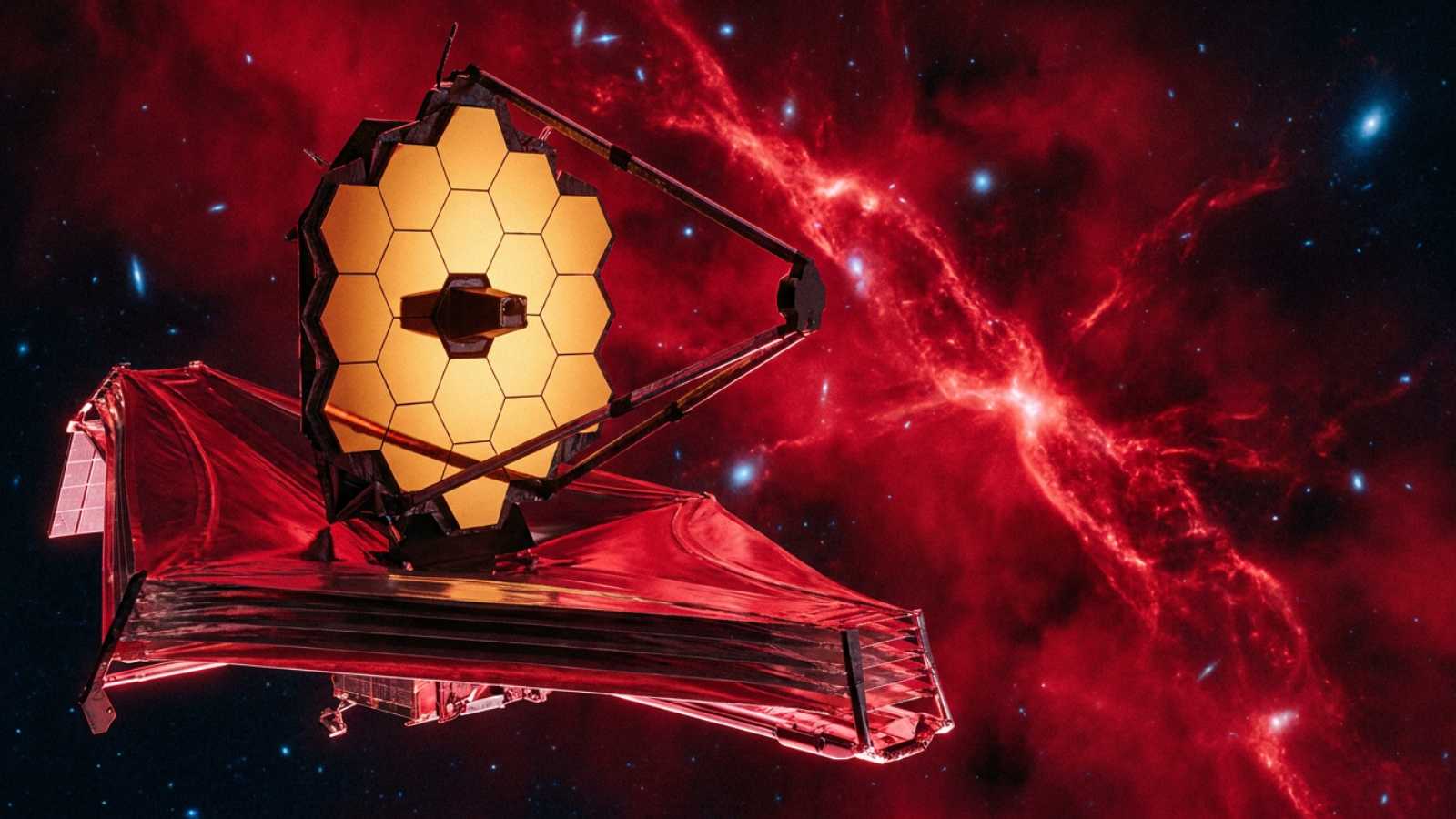
The James Webb Space Telescope (JWST), launched in December 2021, became the main pillar of such observational capability. JWST has a primary mirror with a diameter of 6.5 meters and operates in infrared, enabling detection of light from extremely distant objects because light from the universe's early epoch has undergone massive redshift during its billions of years traveling across the expanding universe.
But JWST does not work alone. Modern cosmic filament research typically relies on a combination of several instruments:
- JWST NIRSpec and NIRCam: For spectroscopy and near-infrared imaging of high-redshift galaxies, confirming distances and chemical composition.
- MUSE at the ESO Very Large Telescope (VLT): An integral field spectrograph highly sensitive to Lyman-alpha emission, ideal for spatially mapping the distribution of hydrogen gas in filaments.
- ALMA (Atacama Large Millimeter/submillimeter Array): To detect dust and molecular gas in galaxies embedded in the filament, measuring mass and temperature independently.
- X-ray Telescopes such as Chandra and eROSITA: To detect hot gas around galaxy clusters at the nodes of filaments.
Equally important advances happened on the data processing side. Modern machine learning algorithms, particularly convolutional neural networks, are now used to separate extremely faint Lyman-alpha emission signals from background noise. A process that once required weeks of manual analysis can now be completed in hours with far greater accuracy and consistency across observers.
Research Directions After This Discovery
The discovery of this 3-million-light-year filament opens at least 3 concrete research avenues being actively pursued.
First, mapping dark matter distribution along the filament. Dark matter cannot be seen directly, but its gravity can be detected through gravitational lensing, the bending of background galaxy light by the mass in the filament. With sufficient lensing data from surveys like Euclid and Rubin Observatory, scientists can create 3D maps of dark matter distribution in structures like this and compare them to simulation predictions.
Second, there are questions about the circumgalactic medium (CGM), gas surrounding galaxies that serves as the interface between the filament and the galaxy itself. Data from the newly detected filament can be used to understand how gas from the filament enters the CGM, is heated or cooled there, before finally falling into the galactic disk and triggering star formation. This remains one of the biggest puzzles in galaxy formation.
Third, large-scale cosmological surveys currently underway will produce catalogs of tens of millions of galaxies. This enables mapping the cosmic web not just at one point in the sky, but across a much larger volume of the universe, comparing structures across different epochs and testing whether the Lambda-CDM model is sufficient to explain everything we observe.
Challenges, Detection Limits, and Open Questions
Before accepting this discovery as the final picture of the cosmic web, there are several critical notes that need to be understood.
Surface Brightness Problem: Cosmic filaments have extremely low surface brightness, several magnitudes below standard detection limits. What was successfully imaged may be only a small portion of a longer, dimmer filament. This is not a specific weakness of this research, but a systematic limit of current instrument physics.
Projection Contamination: A three-dimensional universe is mapped onto a two-dimensional image. Two structures that appear connected in a picture may actually be at very different distances along our line of sight, merely appearing close by coincidence. Researchers use spectroscopic data to confirm distances of individual components through redshift measurements, but ambiguity remains in some projection-dense regions.
Still-Invisible Dark Matter: The dark matter believed to form the "backbone" of filaments cannot be directly observed. All we "see" is baryonic gas comprising about 16 percent of the filament's total mass. The rest is dark matter whose existence can only be inferred from its gravitational effects. This model depends on Lambda-CDM assumptions that remain most consistent with overall data to date, but have not yet been directly confirmed at the individual filament level.
Nearly Undetectable WHIM: Between 40 to 50 percent of baryons in the local universe are estimated to exist as WHIM in cosmic filaments. But WHIM is hard to detect even with the best X-ray telescopes because its emissions are very weak. This is one of the "missing baryon problems" in modern cosmology. The newly discovered filament is primarily detected through phases of cooler, denser gas, not the WHIM that dominates the mass.
Reproducibility: Like all large-scale scientific claims, independent validation by other research groups using different data is a necessary step before this finding can be considered consensus. That process takes time, and it is not a weakness but how science should work.
These notes are not meant to diminish the significance of the finding. Quite the opposite: placing one observation in proper context is what makes the next observation more meaningful. This 3-million-light-year filament is very strong observational evidence that the cosmic web is not just theory. It is real, it is ancient, and it shapes everything in the universe including every atom in our bodies.
Share Article
Share
Disclaimer
All content presented in this article is for informational purposes only and should not be considered as financial advice. The author and publisher are not licensed financial advisors. Any investment decisions made by readers are personal choices, and all risks are solely borne by the reader. We strongly recommend conducting independent research and consulting with a licensed financial advisor before making any financial decisions.