Aave DeFi: $8.45 Billion Bank Run Crisis, KelpDAO Bridge Exploit, and V4 Upgrade Plan

From Bridge Vulnerability to Bank Run: 48-Hour Timeline
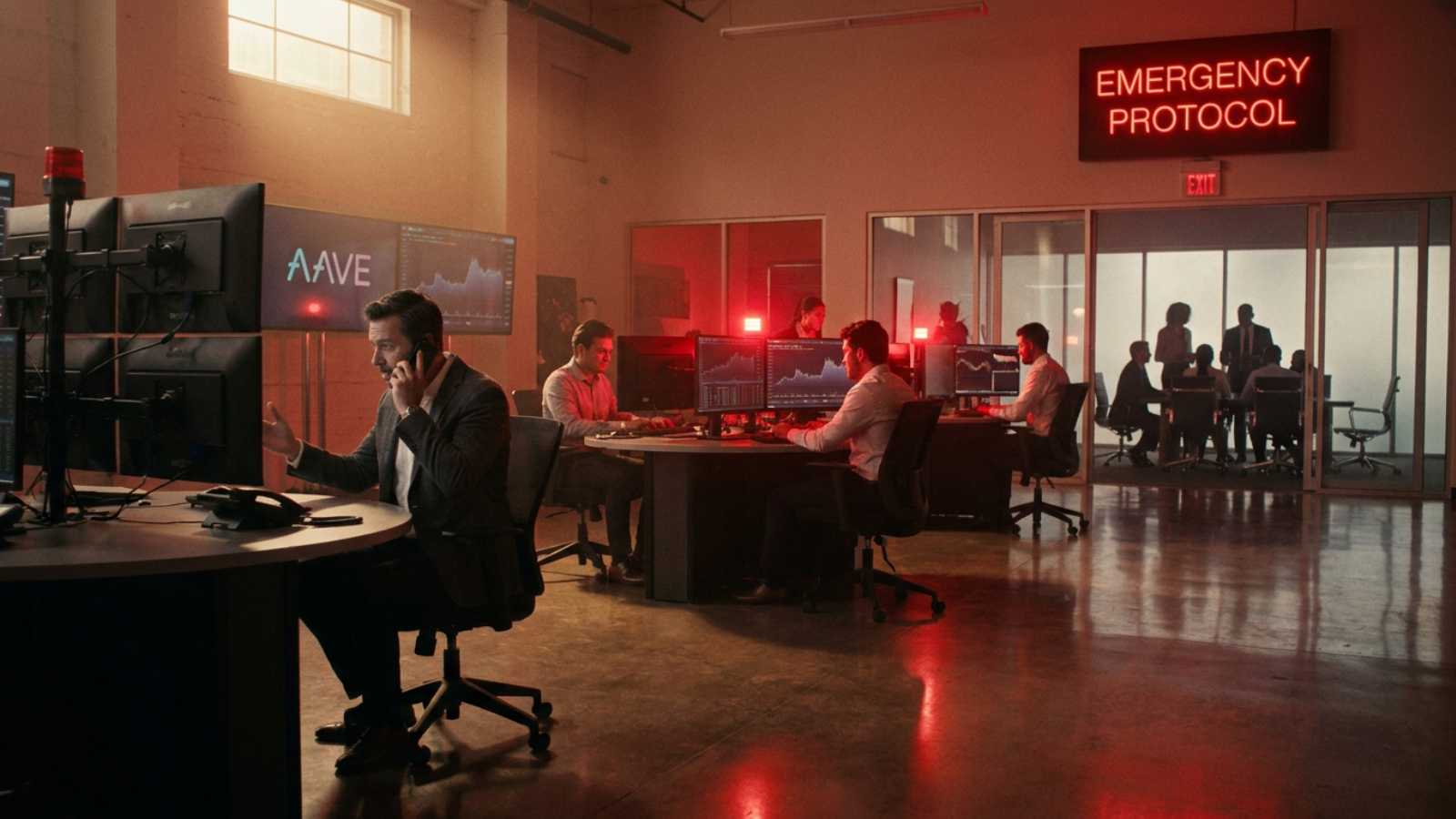
June 8, 2026, 15:17 UTC. On the Aave dashboard, TVL figures that usually moved incrementally began dropping at an unusual pace. Not hundreds of millions. $8.45 billion left the largest lending protocol in Web3 in 2 days, leaving $123.7 million in bad debt and forcing an emergency bailout unprecedented in DeFi history.
Here's what matters: Aave wasn't exploited directly. No Aave smart contract was breached. No admin keys leaked. The actual attack happened at a different layer, on a different protocol, across a different bridge. And that's precisely what makes this crisis far more significant than a single security incident.
KelpDAO Exploit and rsETH Depeg Mechanism
KelpDAO is a liquid restaking protocol that issues rsETH as a receipt token for staked ETH. Users deposit ETH, receive rsETH, then use that rsETH across other DeFi protocols, including Aave, as collateral for stablecoin loans.
For cross-chain functionality, KelpDAO used the LayerZero bridge. This is where the vulnerability lay: the bridge contract failed to properly validate cross-chain messages, allowing an attacker to mint rsETH on the destination chain without depositing equivalent ETH on the source chain. $292 million in unauthorized rsETH was minted.
This instant oversupply destroyed rsETH prices on secondary markets. Depeg occurred within hours. Inside Aave, borrowing positions using rsETH as collateral instantly became undercollateralized. Automatic liquidation mechanisms kicked in, but the volume and speed of the depeg overwhelmed liquidators' capacity to close all positions at viable prices. Bad debt began accumulating.
On-Chain Bank Run Logic Moving Faster than Governance
In traditional banking, bank runs occur because customers don't know the true state of a bank's balance sheet. Uncertainty triggers panic. In DeFi, it should be the opposite: all positions are transparent on-chain, all figures verifiable by anyone.
But transparency creates different dynamics that are no less dangerous.
When Aave bad debt became visible in real time, every depositor faced the same decision at the same moment with identical information. This wasn't uncertainty triggering panic. This was certainty coordinating simultaneous exits at blockchain speed.
Withdrawing early is individually rational when you see bad debt accumulating and doubt the Safety Module covers it adequately. While collectively this action worsens the crisis, no single actor behaves irrationally. Classic prisoner's dilemma executed in 24 hours with no pause.
Aave governance moves slower than this panic. Emergency governance can be activated, but even its fastest version is measured in hours, not seconds. Here lies the fundamental asymmetry in DeFi: panic moves at blockchain speed, governance moves at human speed.
Emergency Bailout and Accountability Controversy
$300 Million Bailout: DAO and Stani's Personal Contribution
When the critical threshold was breached, Aave DAO activated emergency response. The decision:
- 25,000 ETH from Aave DAO Treasury deployed to cover bad debt positions
- 5,000 ETH from Stani Kulechov, Aave founder, as a personal contribution
- Total value reached $300 million, covering most of the troubled positions
Kulechov's move sparked two starkly different interpretations. Part of the community saw it as a strong signal of founder commitment to the protocol during crisis. Others questioned whether this aligned with claims of being a "fully decentralized protocol": if an individual founder can and must serve as the last backstop, where exactly does decentralization lie?
Kulechov himself, per CoinDesk and Crypto.news reporting, publicly maintained Aave's resilience and positioned the crisis as an external exploit targeting a bridge partner, not a direct design failure in Aave. The protocol, in his narrative, successfully passed a stress test of historic proportions.
$123.7 Million Bad Debt and Risk Distribution Across Stakeholders
After the bailout, $123.7 million in bad debt still had to be resolved. Who bears it determines who actually bears the risk in Aave V3's current architecture.
| Stakeholder Category | Risk Exposure | Control Over Risk | Crisis Outcome |
|---|---|---|---|
| USDC/USDT Depositors | High: liquidity can lock during run | Low: exit only via withdrawal | Massive outflow succeeded, but narrow window |
| rsETH-Collateralized Borrowers | Very high: positions subject to forced liquidation | Moderate: can deleverage beforehand | Forced liquidation, some positions became bad debt |
| Safety Module Stakers | Moderate: absorb protocol shortfall | None during crisis unfolding | Absorbs some bad debt post-crisis |
| AAVE Token Holders | Low direct, high via dilution | Via governance voting | Awaiting V4 resolution and minting implications |
| Aave DAO Treasury | Very high: 25,000 ETH deployed | Via emergency governance | Lost 25,000 ETH to cover positions |
What emerges from this table is structural imbalance: ordinary stablecoin depositors, who may have no exposure to rsETH whatsoever, still face liquidity risk because they share the same pool. This is a manifestation of the "shared liquidity, shared risk" principle that forms both the foundation and the weakness of monolithic DeFi lending design.
Stani's Public Position: When "Protocol Succeeds" Isn't Enough
Kulechov's technical argument has solid grounding. Aave contracts weren't breached. Oracles functioned. Liquidations executed. Governance moved. In a narrow technical definition, Aave worked as designed.
But that definition sidesteps the more substantive question: if a DeFi protocol integrates collateral assets whose durability depends on third-party bridge security, and that bridge harbors an undetected vulnerability, is "works as designed" a sufficient standard?
DeFi's ecosystem is built on composability. Each integration adds attack surface beyond the core protocol's control. This isn't a philosophical weakness but a technical trade-off that has been insufficiently weighed in collateral governance parameters. KelpDAO-Aave isn't the first case and won't be the last unless there's structural change in how bridge risk is assessed.
Aave V4: New Architecture to Isolate Risk
Hub-and-Spoke: From Monolith to Modular
Aave V4 was in development before this crisis, but the June 2026 event created urgency that didn't exist before. Core change: transition from monolithic pool architecture to hub-and-spoke model.
In V3, all assets essentially operate within a shared ecosystem. Bad debt from one asset can spread to all protocol depositors. V4 breaks that transmission line with isolation layers:
The isolation logic is straightforward: assets from specific bridges or liquid restaking with high-risk profiles are grouped into their own spoke. If that spoke incurs bad debt, losses are localized. Depositors in prime asset spokes (USDC, WBTC, WETH) don't share losses from exploits in the bridge/restaking spoke.
Euler V2 already applied similar modular philosophy after its own 2023 exploit. Morpho Blue has run with isolated lending markets since launch. What sets Aave apart is TVL scale: migrating from V3 to V4 is far more complex than building a new protocol from scratch.
Cross-Chain Bridge Collateral Standards: The Unstandardized Gap
V4 addresses architectural problems but doesn't directly solve the more fundamental gap: there's no clear industry standard for evaluating bridge risk as infrastructure component of collateral assets.
Smart contract audits assess code quality of the contract itself. They don't assess the security of the cross-chain transport layer that backs it. rsETH may have well-audited contracts. But if the bridge carrying rsETH across chains uses weak validation mechanisms, rsETH's security as collateral only equals the weakest link in its chain.
DeFi lacks a unified framework to assess bridge risk as infrastructure supporting collateral. Smart contract audits evaluate the contract itself, not the cross-chain messaging layer backing it. Aave V4 hub-and-spoke provides architectural response, but without industry-adopted bridge risk assessment standards, other protocols remain vulnerable to similar scenarios.
Several mechanisms are being discussed post-crisis:
- Bridge attestation registry: An on-chain system tracking bridge security track record and automatically adjusting Loan-to-Value ratios for assets depending on that bridge.
- Time-delay oracle: Delay between oracle price updates and liquidation execution, preventing momentary manipulation from triggering cascading mass liquidations.
- Shared insurance pool: Formal mechanism where protocols integrating assets from other protocols contribute to a cross-protocol insurance pool.
None of these mechanisms have standardized implementations yet. All remain in proposal and community discussion stages.
Systemic Risk and Four Unresolved Gaps
Growing Composability Debt
Every new integration a DeFi protocol makes adds what might be called "composability debt": the number of external systems that can affect core protocol security without being under its control. Aave V3 already integrates with dozens of assets across various chains and bridges. Each new integration is added attack surface.
V4 reduces composability debt's impact through spoke isolation. But doesn't reduce the debt itself. As long as DeFi economics push protocols to integrate more assets and chains to compete in the liquidity wars, composability debt keeps growing.
Speed Asymmetry Between Panic and Governance
DeFi bank runs unfold in minutes. Aave governance proposals, even in emergency mode, still require hours. V4 doesn't solve this gap unless there are more granular pre-authorized circuit breakers: crisis response automation executable without full voting periods.
Oracle Concentration and Single-Point Dependencies
Most large DeFi lending still depends on Chainlink as the primary oracle for asset pricing. In conditions of fast and deep depeg like rsETH's case, oracle speed and accuracy directly determine how much bad debt forms before liquidation mechanisms can act.
Comparison of DeFi Bridge Incidents: Historic Scale
| Bridge Incident | Year | Exploit Value | Directly Impacted Protocol | Response Mechanism |
|---|---|---|---|---|
| Ronin Bridge (Axie) | 2022 | $625 million | Sky Mavis | Hard fork + partial reimbursement |
| Wormhole Bridge | 2022 | $320 million | Solana-Ethereum DeFi | Jump Crypto $320 million bailout |
| Nomad Bridge | 2022 | $190 million | Multi-chain ecosystem | No recovery, total loss |
| Multichain Bridge | 2023 | $130 million | Multi-chain ecosystem | No recovery |
| KelpDAO / LayerZero | 2026 | $292 million | Aave (indirect via rsETH) | Aave DAO $300 million bailout |
One critical difference from all previous incidents: for the first time, a large-scale bridge exploit triggered a bank run on a third-party lending protocol that didn't operate the bridge. All 2022-2023 incidents had impacts relatively localized to the bridge ecosystem in question. KelpDAO-Aave proves that 2026 DeFi is sufficiently composited that vulnerability in one layer becomes systemic crisis in another layer that's completely separate technically.
Critical Questions Before V4 Launch
Upgrading Aave V4 with hub-and-spoke architecture is technically sound and has precedent from other protocols. But several operational questions determine how effectively V4 can solve the problems revealed in this crisis:
Migrating liquidity without opening new vulnerability windows. Moving TVL from V3 to V4 at Aave scale creates a transition period that could become a new target. History of large DeFi protocol upgrades often shows migration windows are the most vulnerable moments.
Enforceability of isolation between spokes. If Spoke A and Spoke C must interact for certain composability purposes, how tightly can risk isolation be enforced at the smart contract layer? Interoperability and isolation are structurally opposing objectives.
Rising governance overhead. Hub-and-spoke means Aave governance now manages parameters for multiple spokes simultaneously with very different risk characteristics. This increases voting complexity and opens potential for governance fatigue or parameter misalignment across spokes.
Competitive position against natively modular protocols. Morpho Blue, Euler V2, and next-generation lending protocols operate with modular architecture from the start, without legacy migration burden. Aave V4 must prove superiority not just technically but also in liquidity depth and user experience.
The June 2026 crisis provides extra legitimacy to V4's case, which previously may have sounded merely incremental. After $8.45 billion bank run and $123.7 million bad debt, few need convincing that risk isolation architecture is not optional. What remains are technical and governance questions about implementing it without creating new problems in the process.
Share Article
Share
Disclaimer
All content presented in this article is for informational purposes only and should not be considered as financial advice. The author and publisher are not licensed financial advisors. Any investment decisions made by readers are personal choices, and all risks are solely borne by the reader. We strongly recommend conducting independent research and consulting with a licensed financial advisor before making any financial decisions.