AI Facial Recognition and Wrongful Arrest: The Jalil Richardson Case and Global Algorithmic Bias
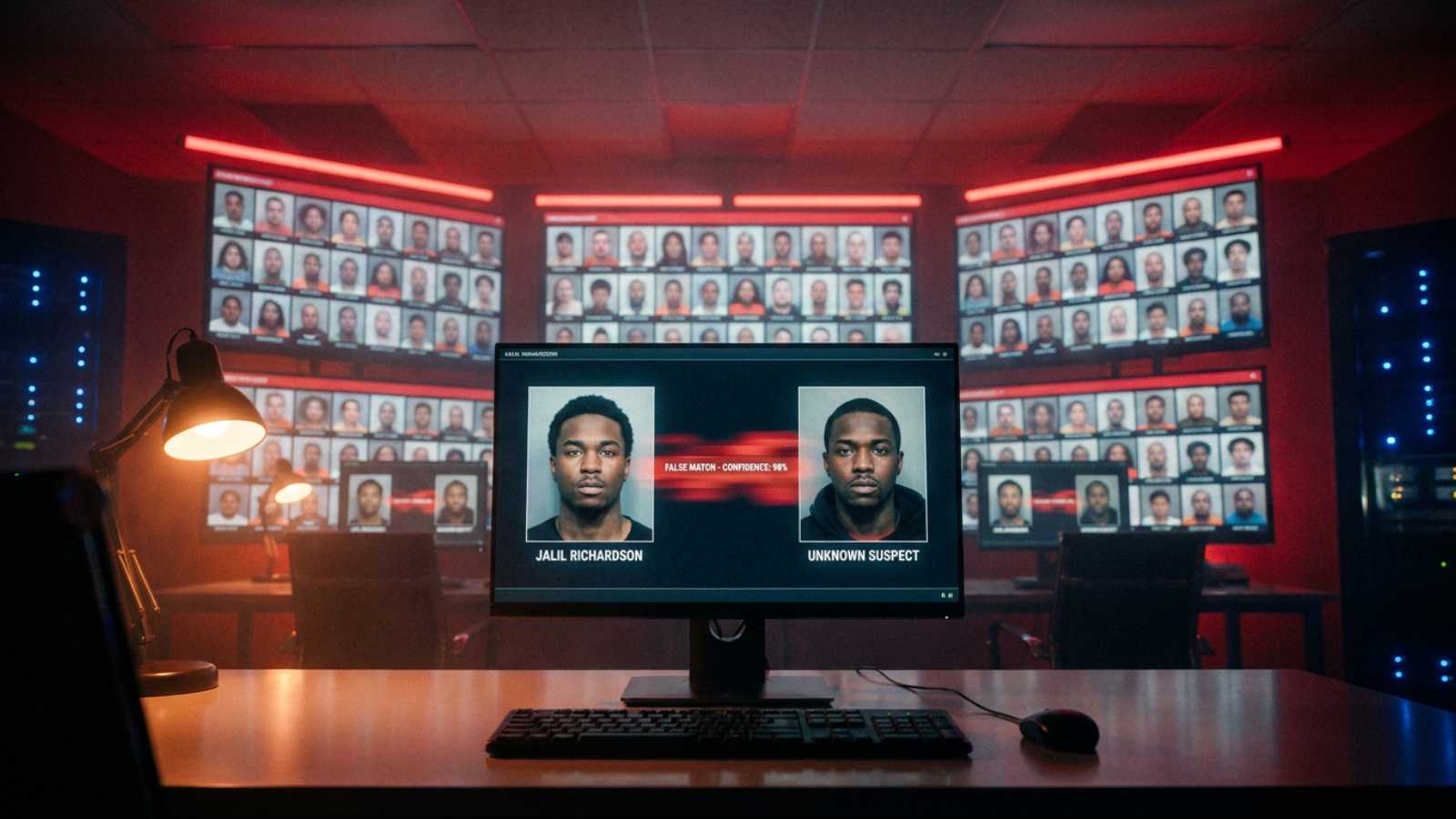

One 85 Percent Match, One Life Collapsed
Jalil Richardson did not know that an algorithm had already flagged him as a suspect before he heard any charges against him. This man from Charlotte, North Carolina was arrested based on a facial match from an AI system that claimed an 85 percent match rate between his photo and a photo of the crime perpetrator. There was no eyewitness who verified his identity at the scene. There was no physical evidence that independently linked him to the location. All there was, was one number from one machine learning model, and that number was enough to set the machinery of law in motion.
The consequences are real and cannot simply be reversed: Richardson lost his job. He lost custody of his child. His life was dragged into a long, expensive, and exhausting legal process because a system misidentified his face.
Richardson's case is not an unexpected technical anomaly. This is a pattern that has already been predicted, already documented, and continues to be allowed to happen.
From Screen to Handcuffs: How Facial Recognition Systems Work in Law Enforcement
The process that brings someone from a photo database to a jail cell happens faster than most people imagine. The workflow is generally:
- Police obtain an image of a suspect from CCTV footage, social media photos, or video frames.
- The image is processed by a
facial recognitionsystem that extracts a numerical vector from facial feature points: distance between eyes, nose width, jaw contour, eye socket depth. - The system compares that vector with a database and outputs a list of candidates with match scores.
- A human investigator, often lacking technical background in statistics or machine learning, uses that list as the basis for investigation or directly as the basis for an arrest warrant.
The critical problem is at step 4. A match score of 85 percent sounds high in everyday conversation. But in the proper statistical framework, it means there is a 15 percent chance the person is not the perpetrator. In a legal system that builds "beyond reasonable doubt" as its foundation, a 15 percent margin of error on the sole "evidence" present is a gap that cannot be ignored.
What is not visible in this diagram are the systemic failure points: blurry images, non-ideal lighting, skewed camera angles, and most fundamentally, the bias already embedded since the model training process began.
Not the First Case, Won't Be the Last
Richardson's case occurs within a longer context. There is already a line of names before him that form this pattern.
Robert Williams is a Detroit resident who in 2020 became one of the first documented cases of wrongful arrest based on facial recognition in the United States. He was arrested in front of his wife and children because the facial recognition system belonging to the Detroit Police Department incorrectly matched his photo with an image from a store security recording. He was detained for 30 hours before being released without charges. Nijeer Parks in New Jersey experienced something similar in 2019, arrested on a facial match error in a case of identity theft. Randal Reid in Georgia faced arrest in 2022, also based on a facial match that turned out to be inaccurate.
All of these cases share the same denominator: their victims were dark-skinned men.
This is not a demographic coincidence. This is a consequence that was predicted by researchers long before these systems were used massively by law enforcement.
| Name | Location | Year | Arrest Status | Direct Impact |
|---|---|---|---|---|
| Nijeer Parks | New Jersey, US | 2019 | Charges later dropped | Detention, legal costs |
| Robert Williams | Detroit, US | 2020 | Released after 30 hours | Family trauma, damaged reputation |
| Michael Oliver | Detroit, US | 2021 | Charges dropped | Temporary job loss |
| Randal Reid | Georgia, US | 2022 | Released after verification | Detention across state lines |
| Jalil Richardson | Charlotte, US | 2026 | Legal process ongoing | Job loss, loss of child custody |
All documented cases in the US confirmed to involve dark-skinned male victims.
What's Wrong: Algorithmic Bias and Demographic Disparity
A comprehensive study from the National Institute of Standards and Technology (NIST) evaluating dozens of facial recognition algorithms found that most systems produced false positive rates significantly higher for faces from African-American, East Asian, and Native American populations compared to white faces. This is not a finding from an advocacy group whose legitimacy can be debated: this is a result from the US federal government itself, published and publicly accessible.
Joy Buolamwini from MIT Media Lab, through the Gender Shades study published in 2018 with Timnit Gebru, documented dramatic disparities: some commercial facial recognition systems showed error rates as high as 34.7 percent for dark-skinned women, compared to less than 1 percent for light-skinned men. This finding prompted Amazon, IBM, and Microsoft to temporarily suspend sales of their facial recognition technology to law enforcement agencies in 2020.
The source of this bias can be traced to a very fundamental point: the composition of training data. Machine learning models learn from the data given to them. If the training dataset consists largely of faces that are not demographically representative of the actual population, the model will become more accurate for groups that are well represented and worse for groups that are poorly represented.
In the context of law enforcement in the US, the historical mugshot databases used to train or test models likely carry bias from the start. That database reflects arrest patterns that occurred previously, and those historical arrest patterns themselves are inseparable from the racial disparities long documented in the justice system. This is a dangerous and self-reinforcing spiral: a biased model produces false arrests on minority groups, data from those arrests feeds back into the system, and the bias hardens from one iteration to the next.
Automation Bias: When Numbers Feel Like Facts
There is a psychological dimension to this analysis that cannot be ignored. Numbers feel objective. When a system says "85 percent match," the human brain tends to treat that as a verified scientific statement rather than a probabilistic estimate from one particular model with uncertainty inherent to it.
This phenomenon is known as automation bias: the tendency to place too much trust in the output of automated systems and reduce the use of independent critical judgment. Investigators without a strong statistics background may not understand that a confidence score of 85 percent from one AI model is not the same as "85 percent chance this person is guilty." Both are fundamentally different statements, and confusion between them can, and has repeatedly proven to, destroy someone's life.
Global Regulatory Response: From EU AI Act to City Bans
The use of facial recognition systems in law enforcement without verified demographic accuracy standards and without strong accountability mechanisms is not merely a technical problem. It is a due process issue that touches on fundamental rights.
Some jurisdictions have begun to move, though with very different approaches and speeds.
The European Union through the AI Act, which began taking effect gradually in 2024, classifies the use of real-time facial recognition systems in public spaces by law enforcement as a practice that is in principle prohibited, with very narrow and strict exceptions for situations like searching for kidnapped victims or identified terrorist threats. This is the most ambitious regulation ever issued by any legislative body in restricting the use of AI in contexts affecting citizens' rights directly.
In the United States, the approach in place is fragmentation. San Francisco banned the use of facial recognition by city government agencies in 2019, becoming the first major city to take this step. Boston, Portland, Minneapolis, and several other cities followed. But there is no federal ban or standard. The police department in Charlotte can use the system as long as there is no North Carolina state regulation explicitly prohibiting it.
The UK takes a different path: not banning, but requiring protocols and audits. London's Metropolitan Police use Live Facial Recognition in public spaces on public safety grounds, but every deployment must follow certain procedures. The result remains controversial, with reports from organizations like Big Brother Watch continuing to document inaccuracies and serious questions about due process.
China sits at the opposite end of the spectrum: integrating facial recognition into nearly every layer of public infrastructure, from train stations to social credit systems, with an absence of independent correction mechanisms equivalent to those elsewhere.
Unresolved Technical, Legal, and Ethical Challenges
Richardson's case opens up several layers of problems that will not be resolved simply by banning or permitting one technology.
Transparency and Auditability That Does Not Exist
Most facial recognition systems used by law enforcement are commercial products with code closed to public audit. When a misidentification occurs, defense attorneys have no mechanism to verify whether the algorithm has a bug, whether the input image quality was too poor for reliable matching, or whether there was a procedural error in how the system was run.
This creates a fundamental epistemological imbalance in the adversarial legal system: prosecutors have access to AI "evidence," but defenders lack the tools to meaningfully challenge it because the model and data are protected by vendor intellectual property claims. In a system where evidence that cannot be challenged by the defense is constitutionally problematic, this is far more than a technical issue.
No Binding Threshold Standard
What minimum match score must be met before someone can be arrested based on facial recognition? There is no federal standard in the US. There is no international consensus. Different police departments use different thresholds, and most do not publish the threshold values they use.
85 percent sounds precise. But in a system with documented demographic bias, even a 95 percent score for certain population groups can still be highly unreliable in producing a correct identification.
Asymmetrical Consequences Between Victims and Systems
- Job loss without severance
- Loss of child custody
- Legal costs borne by no one
- Permanent reputation damage
- Long-term psychological trauma
- Almost never face successful lawsuits
- Models remain in use without mandatory audit
- No obligation for automatic damages
- Government contracts continue uninterrupted
- No market incentive to improve demographic accuracy
Jalil Richardson bears the entire burden of the system's failure. The vendor who sold the system and the department that used it do not face equivalent consequences. There is no automatic compensation mechanism. There is no incentive strong enough to push vendors to improve accuracy on the most harmed demographic groups, because contracts with law enforcement do not require demographic accuracy benchmarks as a condition.
This is a market failure and regulatory failure working together and reinforcing each other.
"Human in the Loop" as a Claim That Needs Proof
The most common argument used by supporters of facial recognition use in law enforcement is that there is always a human making the final decision: there is a "human in the loop." Richardson's case, like cases before it, questions whether that claim is substantive or merely rhetorical cover.
If the human in the loop lacks technical knowledge to critically evaluate AI output, is under institutional pressure to close cases, and faces no personal consequences when their decision is wrong due to over-trusting the algorithm, then that "human in the loop" functions more as a rubber stamp that gives procedural legitimacy to a decision actually already made by the automated system.
Pressure Toward Stronger Standards
Richardson's case, which occurred in June 2026, has revived demands for federal regulation in the US. Proposals like the Facial Recognition and Biometric Technology Moratorium Act that have been submitted to Congress have not yet become law. But pressure from civil rights organizations like the ACLU and Electronic Frontier Foundation, from academics in AI ethics and law, and from an growing number of legislators from both parties, continues to build momentum.
At the international level, there is a growing awareness that a coordination framework equivalent to GDPR is needed in the context of biometrics and AI. The EU AI Act applies only to European territory. NIST in the US produces technical guidance, not binding regulation. An international convention specifically governing the use of AI biometrics in law enforcement does not yet exist, and the path toward establishing one remains long.
What is already clear from the series of documented cases: facial recognition use in law enforcement should not be treated by the standard of "good enough for most cases." When its failure means someone loses freedom, their job, and custody of their own child, the standard that applies must far exceed what exists today. And that standard will not come voluntarily from vendors profiting from system sales, nor will it emerge from within law enforcement institutions that have already integrated this technology into their daily operations.
Jalil Richardson paid the price for the absence of that regulation. The question now is: how many more cases need to be documented before the legal and legislative systems in various countries move at a speed proportional to the scale of the damage.
Share Article
Share
Disclaimer
All content presented in this article is for informational purposes only and should not be considered as financial advice. The author and publisher are not licensed financial advisors. Any investment decisions made by readers are personal choices, and all risks are solely borne by the reader. We strongly recommend conducting independent research and consulting with a licensed financial advisor before making any financial decisions.