BlackRock and Fidelity Dominate Bitcoin ETFs: An Analysis of Market Consolidation and Structural Risks

Two Names, 90% of the Capital
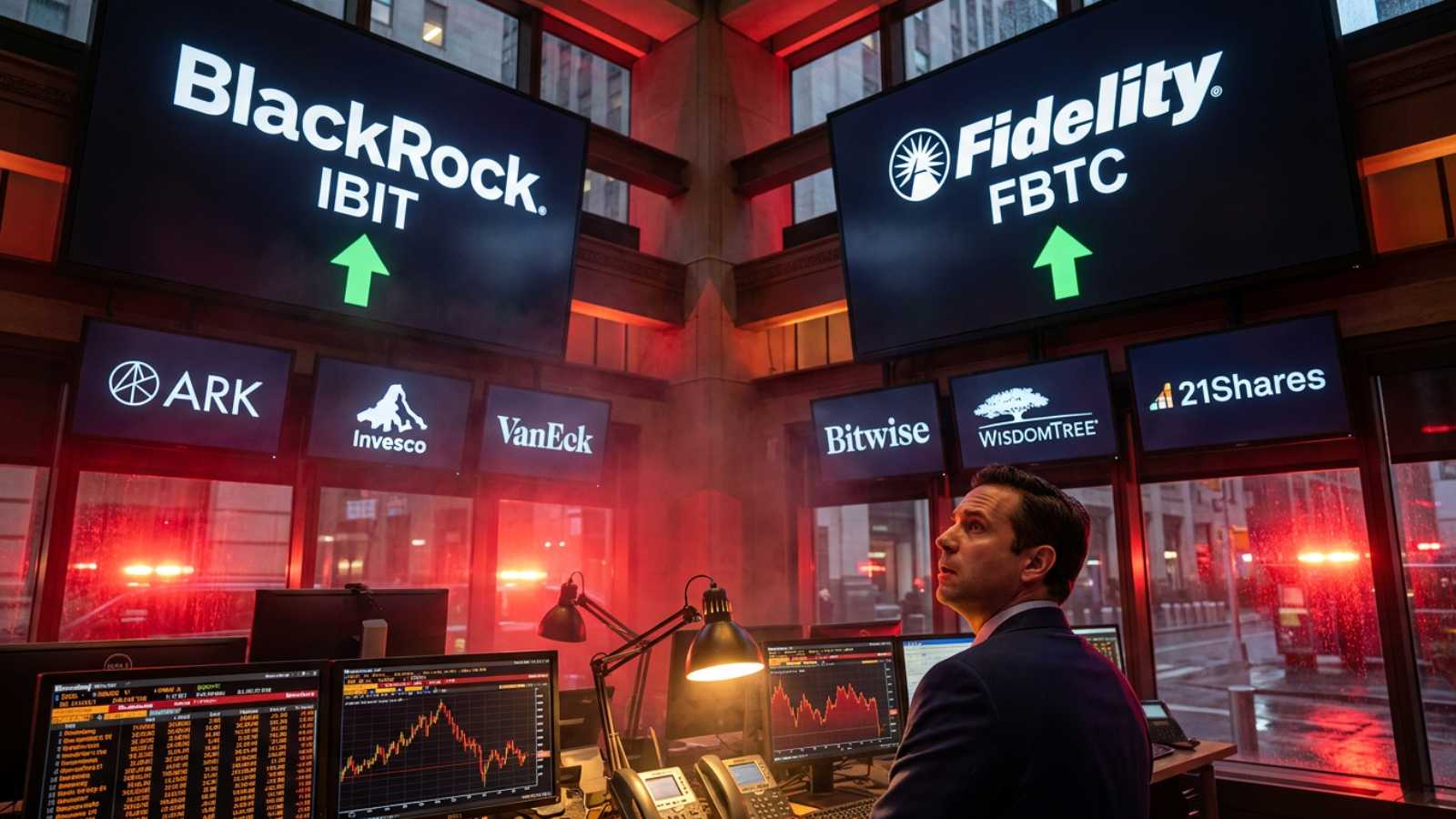
Data released on June 10, 2026 requires little interpretation: BlackRock IBIT and Fidelity FBTC consistently absorbed more than 90% of total Bitcoin ETF inflows on various trading days throughout 2026. The remaining 8+ products from other competitors, including ARK/21Shares, Invesco, VanEck, Bitwise, and WisdomTree, compete for a share of less than 10%.
This is not merely a small difference between one player and another. This is a market structure that, in ETF industry terminology, is called "winner-take-most": a condition in which 2 of 10+ players capture a distribution of capital that is entirely disproportionate to the number of products available.
For global investors, this pattern is not merely a statistical figure. It is a fundamental reconfiguration of who truly determines the flow of capital to Bitcoin through traditional financial channels.
Consolidation Mechanics: Why Capital Flows to IBIT and FBTC
The first spot Bitcoin ETF in the United States received SEC approval in January 2024. From day one, more than 10 products were launched almost simultaneously. In theory, open competition. In practice, institutions did not choose evenly.
There are several structural factors that allowed IBIT and FBTC to leap far ahead of competitors immediately, and these factors reinforce one another.
Distribution and gravitational pull of institutional brands. BlackRock manages assets worth several trillion dollars and maintains direct relationships with thousands of wealth advisors, pension funds, sovereign wealth funds, and global financial institutions. When IBIT becomes available on their distribution platform, recommendations to institutional clients run almost automatically. Fidelity possesses a similar pathway through Fidelity Institutional and Fidelity Brokerage, with tens of millions of active accounts already familiar with their product ecosystem.
Liquidity snowball effect. ETFs with high trading volume attract tighter bid-ask spreads. Tighter spreads mean lower transaction costs for large traders and institutions. That attracts more volume, which narrows spreads further, which attracts more volume again. Competitors starting with small AUM get trapped in the opposite spiral: wide spreads, low volume, spreads widening further.
Institutional minimum requirements. Risk management policies at most institutional investors mandate certain minimum AUM and trading volume track records before a product can enter their recommended list. These requirements only IBIT and FBTC could meet within a relatively short timeframe after launch. Competitors, despite offering lower fees on paper, had no time to meet those thresholds.
That feedback loop—more capital flowing in making the product more liquid which attracts more capital—has gone too deep for competitors to chase without drastic price intervention or product differentiation.
Current Competitive Landscape
As of June 2026, the global Bitcoin ETF landscape is dominated by products based in the United States, with similar products also operating in Canada, Germany, and several other European jurisdictions. Here is a comparative overview of major products based on publicly available information:
| Product | Manager | Ticker | Exchange / Market | Competitive Position |
|---|---|---|---|---|
| iShares Bitcoin Trust | BlackRock | IBIT | NYSE Arca (US) | Dominant, largest inflows |
| Fidelity Wise Origin Bitcoin Fund | Fidelity | FBTC | CBOE BZX (US) | Dominant, second-largest inflows |
| ARK 21Shares Bitcoin ETF | ARK/21Shares | ARKB | CBOE BZX (US) | Mid-tier competitor, loyal retail base |
| Bitwise Bitcoin ETF | Bitwise | BITB | NYSE Arca (US) | Mid-tier competitor, crypto-native niche |
| VanEck Bitcoin Trust | VanEck | HODL | CBOE BZX (US) | Small competitor |
| WisdomTree Bitcoin Fund | WisdomTree | BTCW | CBOE BZX (US) | Small competitor |
| Invesco Galaxy Bitcoin ETF | Invesco/Galaxy | BTCO | CBOE BZX (US) | Small competitor |
| 21Shares Bitcoin ETP | 21Shares | ABTC | Euronext/Xetra | Focused on European market |
Classification based on relative inflow patterns per CoinDesk report, June 10, 2026. Specific AUM data not listed as it changes daily.
Mid-tier competitors like ARK/21Shares and Bitwise can still survive thanks to niche positioning and established investor communities. Bitwise, for instance, built a reputation as a manager that is more "crypto-native" than the two traditional giants. But that gap narrows as IBIT and FBTC continue to widen their AUM advantage.
Concrete Implications for Retail Investors
For retail investors, this consolidation carries a dual effect. There are tangible direct advantages, but also structural risks often overlooked in the "mass adoption of Bitcoin" narrative.
Advantages that are directly felt. Tight bid-ask spreads on IBIT and FBTC mean less slippage when executing orders. For investors entering and exiting in significant amounts, the spread difference between super-liquid products and those with low volume can be financially meaningful. The presence of BlackRock and Fidelity also provides a layer of regulatory credibility that niche products don't possess: it is unlikely that two entities of this caliber would collapse suddenly or engage in operational fraud.
Hidden risks behind liquidity. When most Bitcoin exposure via ETF is concentrated in two entities, systemic risk exposure rises. If internal policies at BlackRock or Fidelity regarding digital assets shift—whether due to regulatory pressure, executive leadership change, or ESG perspective shifts from major clients—the impact can be felt immediately in spot Bitcoin prices globally. This differs from a scenario where 15 products with more evenly distributed AUM absorb and distribute selling pressure more broadly.
"When 2 firms control most of the capital flows in a particular asset class, they effectively become de facto market makers, not through formal mechanism, but through the gravitational pull of the AUM they attract every day."
This is not abstract theory. In the US bond market, BlackRock through iShares already demonstrated this pattern years before regulators began questioning its implications for price discovery and market stability.
Narrowing competitive choices. Fee compression that typically benefits consumers in competitive markets begins to work in reverse here. Smaller competitors offering lower fees fail to attract inflows because investors prioritize liquidity and brand names. If these competitors eventually shut down products because they are not economically viable, investors lose alternatives. The remaining market will contain only IBIT, FBTC, and perhaps 2 to 3 niche products able to survive.
Possible Directions Ahead
Two scenarios are developing simultaneously, and neither is mutually exclusive.
Scenario 1: Deeper consolidation in the US market. Several small Bitcoin ETF products already show signs of economic pressure. Thin management fees divided over small AUM do not sufficiently cover costs of operations, custody, audit, and compliance that continue to increase. If inflow concentration in IBIT and FBTC persists, a wave of small product closures or mergers is very likely before the end of this decade.
Scenario 2: Expansion of Bitcoin-based products beyond standard spot ETFs. BlackRock and Fidelity will not stop at simple spot products. Products adding options components, yield enhancement, or integration with multi-asset portfolios in a single ETF wrapper will very likely emerge. This actually opens space for niche competitors to specialize in different product segments rather than compete head-to-head in the standard spot ETF market.
A third, longer-timeline scenario: Europe and Asia develop their own Bitcoin ETP ecosystems independent of US distribution. Germany via Euronext/Xetra, Switzerland, and Canada already have similar products. If liquidity in non-US markets grows significantly, the dominance of IBIT and FBTC becomes more limited to a US-centric context.
Structural Risks and Unanswered Questions
This market concentration is not merely a typical business competition issue. There are more fundamental questions relevant to anyone holding positions in the digital asset market.
Does this create a single point of failure in the Bitcoin market? If BlackRock and Fidelity face massive redemptions simultaneously—whether due to global liquidity crisis, forced regulatory policy, or other force majeure—the impact on spot Bitcoin price would be far greater than if the market were evenly distributed among many players. This is not an argument against ETFs as an investment mechanism, but against unhealthy concentration in one or two large entities.
Regulatory concerns regarding custody concentration. Both IBIT and FBTC use institutional custody models dependent on specific custodian partners. As concentration of spot Bitcoin ownership continues to rise under the umbrella of these two firms, the question of whether regulators need to enforce concentration ownership limits becomes increasingly relevant. The SEC and FSOC in the US have not publicly stated specific concerns about this. But precedent from traditional finance shows regulatory oversight tends to come after problems occur, not before.
When 2 entities control 90%+ of inflows in an asset class designed for decentralization, the question is not just about market structure. It is about what it means to hold Bitcoin exposure through an institutional-wrapped product versus holding the keys yourself in a wallet. This philosophical difference becomes increasingly important as institutional concentration continues to grow without adequate balancing mechanisms.
Impact on Bitcoin's decentralization narrative. Satoshi Nakamoto designed Bitcoin as a system without central authority. A deep irony emerges when 2 of the world's largest asset management companies control most of Bitcoin exposure via tightly regulated SEC-overseen ETF wrappers. Beneficial ownership remains legally in the hands of individual investors, but operational control over when to buy, when to sell, and how to react to crises rests with BlackRock and Fidelity. Not on the blockchain, not in the node community, not with miners.
Fee race to zero and long-term implications. Fee compression pressure continues as competitors attempt to attract attention through lower costs. This benefits investors in the short term. But ETF manager business models relying on thin fees spread over large AUM are only viable at certain scales, and again, only the two dominant players possess that scale. When small competitors can no longer survive despite low fees, the only leverage remaining for investors to secure better treatment from IBIT and FBTC is to move to non-ETF products, including direct self-custody.
Questions about industry representation. ETFs do not give shareholders voting rights over Bitcoin protocol decisions, unlike governance tokens in DeFi. But when BlackRock and Fidelity become the most-listened-to voices in various industry forums, public policy dialogues, and regulatory meetings on Bitcoin in Washington, Brussels, and Tokyo, the claim that they are "merely" managing passive investment products starts to feel disproportionate to the influence they wield.
This consolidation is not a market anomaly that will self-correct in the near term. It is a pattern that repeats in every new asset class entering the mainstream financial pipeline: easier access for regular investors, deeper liquidity, but increasingly centralized distribution of power. The question is not whether IBIT and FBTC deserve to dominate because they built stronger distribution. The question is what happens to prices, market resilience, and Bitcoin's promise of decentralization when this concentration grows without an equivalent counterweight.
Share Article
Share
Disclaimer
All content presented in this article is for informational purposes only and should not be considered as financial advice. The author and publisher are not licensed financial advisors. Any investment decisions made by readers are personal choices, and all risks are solely borne by the reader. We strongly recommend conducting independent research and consulting with a licensed financial advisor before making any financial decisions.