Downstream Processing, Danantara, and #SellSingapore: Reading Indonesia's 2025-2026 Exports
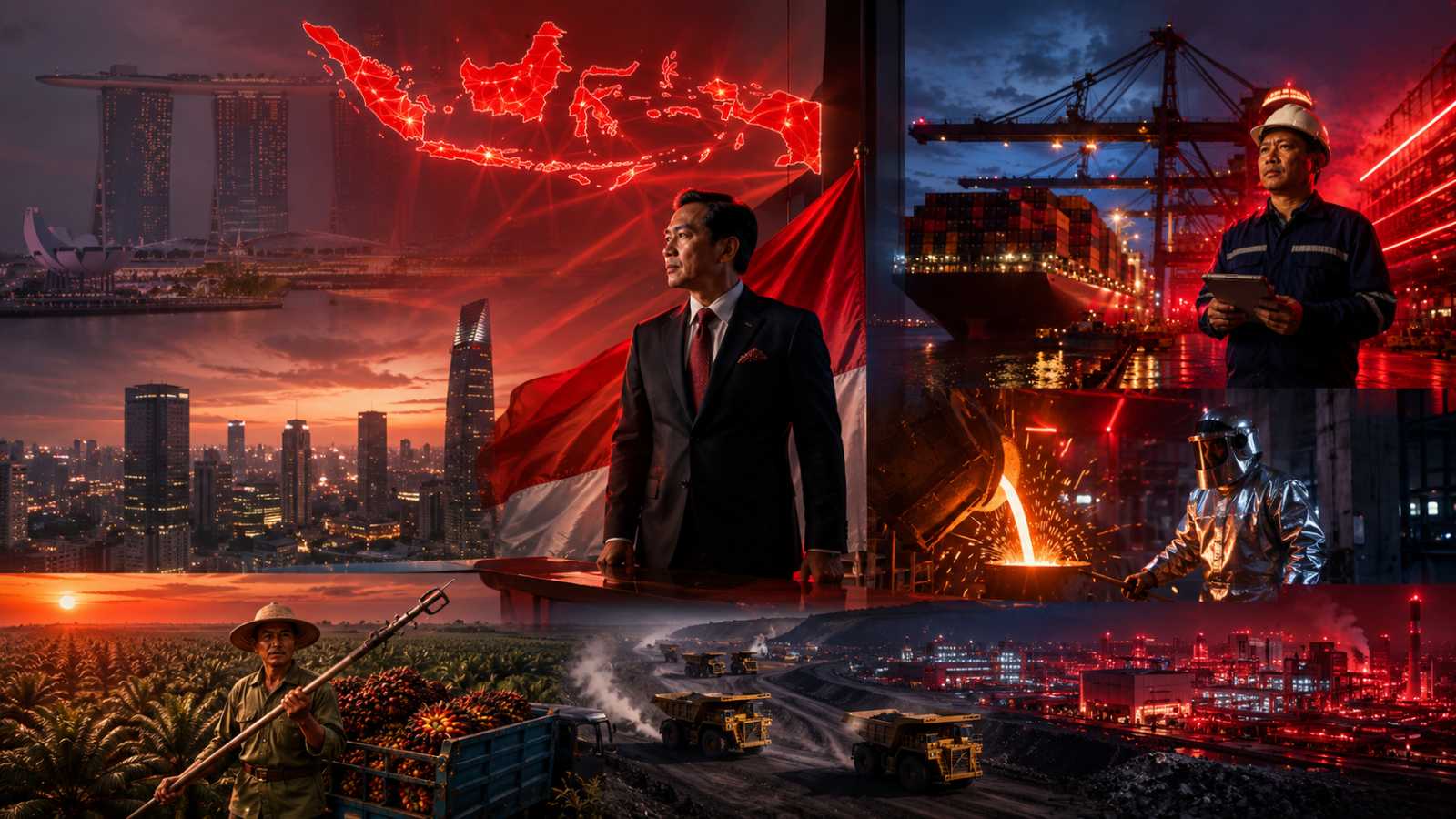

The Rise of Indonesia: Industrial Ambitions Behind the Sell Singapore Movement
Numbers first, narrative later. From January through December 2025, Indonesia's exports reached $282.91 billion, roughly Rp 5,083 trillion, up 6.15 percent from 2024. The trade balance has been in surplus for 71 consecutive months. January through October 2025 alone recorded a surplus of $35.88 billion (about Rp 645 trillion), nearly $11 billion higher than the same period the year before.
A second number, more striking. Nickel sector exports in 2017 sat at just $3 to $4 billion. By 2024, after the ban on raw ore exports and with downstream processing in full swing, that figure exploded to roughly $34 billion, or Rp 611 trillion. Tenfold in seven years, simply because Indonesia decided to stop shipping out raw material.
The hashtag #SellSingapore surfaced on public timelines, not as a literal proposal to sell an island. It was how netizens mocked and challenged a single reality: for years, the added value of Indonesian commodities flowed to a neighboring financial hub via transfer pricing, under-invoicing, and offshore parking of foreign exchange. Raw materials went out, processed products were bought back at premium prices, and the rupiah carried the weight of that invisible deficit. Public sentiment finally met official data, and the discussion shifted from rhetorical complaint to policy argument.
The government responded with instruments, not speeches. Starting 2026, Danantara Sumberdaya Indonesia (SDI) is tasked with supervising the exports of three giant commodities that contribute around 23.4 percent of national foreign exchange. As of 1 January 2027, the agency will hold full control over the export chain for palm oil, coal, and ferronickel, from sales contracts and shipping through to payment receipts.
Anatomy of the 2025 Export Engine: Non-Oil and Gas Takes Command
The 2025 export composition speaks louder than any chart. The non-oil and gas sector contributed $269.84 billion (about Rp 4,848 trillion), growing 7.66 percent year on year. Oil and gas managed only $13.07 billion (about Rp 235 trillion), down 17.69 percent as global energy prices weakened. This is not just a seasonal compositional shift. Indonesia's export structure is genuinely no longer dependent on oil and gas.
Processing industries are the backbone. BPS explicitly points to downstream processing as the prime driver. The logic is simple: raw nickel ore sells for hundreds of dollars per ton, battery precursors can fetch several thousand dollars per ton. The gap is added value that previously evaporated in the hands of foreign traders.
| Commodity | 2025 Export Value | Rupiah Estimate | YoY Trend |
|---|---|---|---|
| Total national exports | $282.91 billion | Rp 5,083 trillion | +6.15% |
| Non-oil and gas exports | $269.84 billion | Rp 4,848 trillion | +7.66% |
| Oil and gas exports | $13.07 billion | Rp 235 trillion | -17.69% |
| Nickel downstream (2024) | $34 billion | Rp 611 trillion | 10x since 2017 |
| Coal | $24.48 billion | Rp 440 trillion | -19.70% |
| CPO and derivatives | $24.42 billion | Rp 439 trillion | +21.83% |
| Copper concentrate (Jan-Nov) | $4.55 billion | Rp 82 trillion | rising trend |
| Combined Danantara trio | $66.13 billion | Rp 1,188 trillion | 23.4% of total exports |
Three countries dominate the demand side. China at $52.45 billion (about Rp 942 trillion) for January through October 2025, the United States at $25.56 billion (about Rp 459 trillion), India at $15.32 billion (about Rp 275 trillion). In the first four months of 2026, non-oil and gas exports to China alone jumped 20.58 percent to $22.76 billion (about Rp 409 trillion). The demand engine is still running hard.
Entering 2026, momentum has not slackened. From January through April 2026, non-oil and gas exports still grew 6.28 percent to $87.74 billion (about Rp 1,577 trillion). Processing industries contributed 7.71 percent to the total export increase. The sharpest gainers: processed nickel, CPO, basic organic chemicals, basic inorganic chemicals, plus semiconductors and electronic components. CPO and derivative exports rose 16.59 percent to $8.22 billion (about Rp 148 trillion). Coal, by contrast, remained under pressure at $7.57 billion (about Rp 136 trillion), down 7.27 percent.
The quick lesson: raw commodities ride global price cycles with little room to negotiate. Processed products carry more stable pricing power. That is why downstream processing is not policy ornamentation, it is industrial bone structure.
Five Commodity Pillars Reshaping the Bargaining Position
Nickel: The Sharpest Downstream Case Study
Indonesia holds the world's largest nickel reserves and is its biggest producer, supplying nearly half of global output. What gets shipped out is no longer raw ore. Now it is ferronickel, nickel matte, nickel sulfate, battery precursors, and components for the electric vehicle ecosystem. The ecosystem is layered: mining, smelting, stainless steel, battery cells, battery packs, and battery recycling. Industrial hubs are growing in Morowali, Weda Bay, and the Central Sulawesi industrial zone, becoming the gravitational center of Asia's EV supply chain.
Coal: The Aging Cash Cow
Throughout 2025, Indonesia shipped 390.3 million tons of coal worth $24.48 billion (about Rp 440 trillion). The 19.70 percent decline came more from global price correction than from volume drop. Coal remains a pillar of energy security for Asian countries, but the chart tells a story: dependence on a single commodity whose price moves outside Jakarta's control will always carry high risk.
Palm Oil: Green Gold Moving Up Market
Indonesia is the world's largest palm oil producer. CPO and derivative exports in 2025 reached $24.42 billion (about Rp 439 trillion), up 21.83 percent from $20.05 billion in 2024. In December 2025 alone, export volume hit 2.75 million tons worth $2.79 billion (about Rp 50 trillion), up 66.80 percent year on year. Palm oil supplies global food, cosmetics, oleochemicals, and biodiesel, while absorbing millions of workers across Sumatra and Kalimantan.
Copper: Lifeline of the Electrification Era
Copper is a vital component for electrical infrastructure, electric vehicles, data centers, and digital transformation. Copper concentrate exports from January through November 2025 hit $4.55 billion (about Rp 82 trillion). With giant smelters operating in Gresik and Sumbawa, Indonesia is moving toward exporting copper cathodes, which fetch far higher value per kilogram. The nickel story could repeat itself, this time in a commodity whose demand is surging alongside global electrification.
Tin, Bauxite, and Natural Gas
Indonesia is one of the world's largest tin producers, with a strategic position in the global electronics and semiconductor supply chain. Bauxite, whose raw exports have been banned, is now being directed toward domestic processing into alumina and aluminum, the foundation for transportation, construction, and high-tech industries. Indonesia also remains an important LNG supplier in the Asia Pacific region, playing a role in regional energy security.
Raw materials shipped out, processed products bought back at a premium. That was the old pattern. The new pattern: raw materials banned from export, smelters built, then high-margin processed products shipped out. The gap no longer evaporates.
Downstream Processing of 28 Commodities and the Danantara Chapter
The government has mapped out 28 commodities under the national downstream program, with investment needs of $500 to $550 billion, roughly Rp 8,984 to Rp 9,882 trillion (exchange rate Rp 17,968/USD) over the long term. Initial-phase investment of $40 billion (about Rp 719 trillion) has been approved since 2025. Of the total Rp 1,700 trillion in investment received in 2024, around 30 percent flowed into downstream sectors. This is not a small policy experiment, it is a structural bet on a decade-long scale.
Danantara Sumberdaya Indonesia becomes the main instrument for locking down foreign exchange flows. During the transition period through the end of December 2026, exporters can still ship goods as usual but must report transaction details electronically. Starting 1 January 2027, Danantara SDI will hold full control over the export chains for palm oil, coal, and ferronickel, from contract to shipping to payment. The objective is clear: close the gaps for under-invoicing and transfer pricing, while ensuring foreign exchange earnings settle inside the domestic financial system to strengthen the rupiah.
This policy combination directly answers the criticism behind #SellSingapore. Foreign exchange is no longer parked in a neighboring jurisdiction while the rupiah weakens. Transaction values can no longer be set arbitrarily by traders who control both the seller and the buyer side.
Indonesia and Singapore: A Shifting Center of Gravity
The economic relationship between Indonesia and Singapore remains complementary. Singapore excels as a financial hub, an international trade center, and a global investment management base. Indonesia excels with a large domestic market, strategic natural resources, a productive workforce, and long-term industrialization potential. The Indonesia-Singapore axis is still one of the hearts of Southeast Asia's economy.
But the center of gravity is shifting. With the export foreign exchange (DHE) policy mandating domestic placement of FX earnings, governance strengthening through Danantara, plus world-class industrial centers in Morowali, Weda Bay, Gresik, and Kalimantan, Indonesia is gradually pulling back the share of value added that has long been enjoyed by the regional financial hub. Singapore is not disappearing from the map. Its position is just no longer the automatic default destination for parking Indonesian foreign exchange.
#SellSingapore, traced to its root, was never about expelling a neighbor. It was how netizens named a long-deferred policy question: how could a resource-rich country let added value run off elsewhere for decades? The answer, in part, is being stitched together by the combination of DHE, downstream processing of 28 commodities, and Danantara control.
Risks, Challenges, and Unfinished Questions
The optimism of the 2025 numbers should not mask structural weak points. Several real risks deserve attention.
First, dependence on China as the primary buyer. Non-oil and gas exports to China hit $52.45 billion in January through October 2025, far outpacing the United States and India. The 20.58 percent surge in early 2026 shows the trend is taking deeper root. Market concentration like this has two faces: good when Chinese demand is strong, fragile when geopolitics or an economic slowdown forces Beijing to catch its breath. Market diversification is not an option, it is insurance.
Second, commodity price sensitivity. The 19.70 percent drop in coal export value across 2025 and the follow-on 7.27 percent contraction in early 2026 show how fragile the bargaining position of a raw material supplier is. Downstream processing has changed this profile for nickel and copper, but for coal and several other mining commodities, prices are still set outside Jakarta.
Third, Danantara's execution capacity. Taking control of the export chain for three commodities worth $66.13 billion is not routine administrative work. Execution risks include operational disruption for large exporters during the transition, potential bureaucratic inefficiency, and the need for technology systems that can handle global transaction volumes. If implementation stalls in 2027, the momentum already built could lose market confidence.
Fourth, the ethical and environmental dimension of nickel downstream processing. Smelters need massive energy, and most captive coal-fired power plants in the nickel industrial zones still run on coal. Global market demands, especially from Europe and premium EV producers, are getting tighter on carbon footprint. Without an energy transition on the smelter side, the "clean nickel" label that anchors marketing could be rejected by premium buyers.
Fifth, coordination with the export foreign exchange policy. An effective DHE must be matched with attractive domestic financial instruments, so that foreign exchange is not just compulsory parking but also productive. If domestic yields lag far behind neighboring jurisdictions, the pressure to find loopholes will persist.
The initial capital is in place, and the data is real. A population of 280 million, strategic resource reserves, and processing industries starting to move up market form the foundation. Exports cracked Rp 5,083 trillion in 2025, the trade surplus held for 71 straight months, nickel export value leapt tenfold, and non-oil and gas exports in early 2026 are still growing above 6 percent.
What translates numbers into economic sovereignty is not the numbers themselves. What translates them: consistent policy, decisive execution, coordination across ministries and agencies, plus the discipline to ensure added value truly settles at home. #SellSingapore in the end is only a symbol. The real work lies in the governance of downstream processing across 28 commodities, Danantara's capacity to deliver on its mandate in 2027, and the rupiah's ability to absorb the foreign exchange flows now required to park domestically. The results will only become clearly readable in the years ahead, and that is the Indonesian economic bet now underway.
Share Article
Share
Disclaimer
All content presented in this article is for informational purposes only and should not be considered as financial advice. The author and publisher are not licensed financial advisors. Any investment decisions made by readers are personal choices, and all risks are solely borne by the reader. We strongly recommend conducting independent research and consulting with a licensed financial advisor before making any financial decisions.