Ethereum Falls to 13-Month Low After Critical Zcash Vulnerability Disclosed
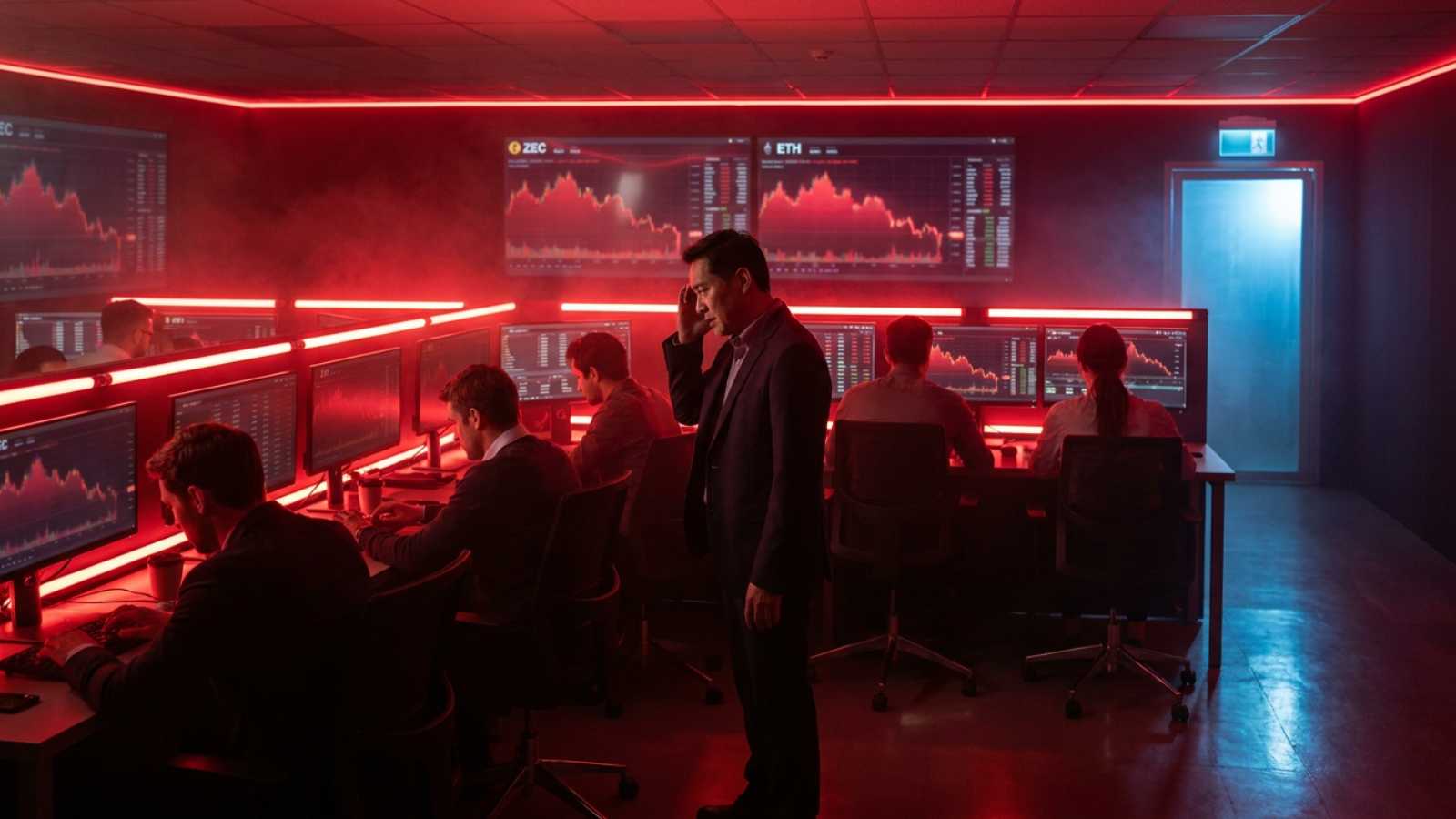

ETH Price Pierces Below $1,600: More Than Just a Technical Correction
June 5, 2026, 22:18 UTC. X and Reddit feeds suddenly fill with one topic: Shielded Labs just announced the discovery of a critical vulnerability in the Zcash protocol. The vulnerability went undetected for 4 years. ZCASH price immediately collapsed between 38 and 40 percent in a matter of hours.
But the scale of ZCASH's decline is not the most striking part of that day. More striking is the movement in Ethereum: ETH fell below $1,600, touching its lowest level in 13 months, piercing a point last reached in early 2025. 2 assets with no direct architectural connection. 2 development teams working in different domains. Yet one security announcement was enough to pull both down together.
If you were watching the ticker and searching for the next support level for ETH, that question is fair. But there is a more important question: why can a vulnerability in a privacy coin with a market cap far smaller than Ethereum trigger a 13-month decline on the world's second-largest layer-1?
The answer is not about price correlation between assets. The answer is about how the market reprices confidence in the security of blockchain infrastructure as a system.
What Shielded Labs Found and Why It Is Not Ordinary News
Zcash is not a small or experimental project. Launched in October 2016, it was built by a team of cryptography researchers from Johns Hopkins, MIT, and Technion. Zcash is one of the first blockchain implementations to use zk-SNARK (Zero-Knowledge Succinct Non-Interactive Argument of Knowledge) in the context of a public network operating in the real world.
zk-SNARK allows someone to prove that a statement is true without revealing any information beyond the fact that the statement is true. In Zcash's context, this technology powers shielded transactions: transactions where the amount, sender identity, and recipient identity are all hidden from the public, yet their validity can still be verified cryptographically.
This is the technical foundation supporting Zcash's entire value proposition. And this is what came into question when Shielded Labs announced there was a vulnerability hidden for 4 years within this system.
Conceptually, the verification system at the heart of shielded transactions can be represented like this:
Where vk is the verification key, x is the public input (claim about transaction validity), and π is the zero-knowledge proof generated by the prover. The soundness property guarantees that no dishonest prover can generate a valid π unless they actually possess the claimed knowledge.
A 4-year vulnerability means this property was potentially manipulated throughout that long period. The specific technical details of this bug had not been fully published at the time this article was written, but for the market, the ambiguity itself was enough to trigger massive repricing.
Because the question in doubt is not just "is ZCASH worth holding?" Rather: "how confident are we that the cryptographic audits already conducted across the entire blockchain ecosystem are actually comprehensive?"
Contagion Mechanism: From Privacy Coin to Ethereum
Ethereum differs from Zcash in almost every relevant technical dimension: a proof-of-stake consensus model based on validators, smart contract architecture versus UTXO model with shielded pool, a DeFi ecosystem worth hundreds of billions versus more specific privacy use cases. Technically, there is no direct connection.
But the market does not always operate on direct technical relationships. It operates on confidence and risk perception.
Contagion operates through at least 3 parallel channels active simultaneously.
Wide repricing of risk premium. When a protocol with a solid reputation for security turns out to harbor a critical vulnerability for 4 years, investors cannot isolate distrust to Zcash alone. The question that surfaces automatically: how many similar vulnerabilities might exist in Ethereum, in the DeFi protocols running on top of it, in the L2 rollups that aggregate transactions to the ETH mainnet? No one can answer "zero" with full confidence, and the inability to answer becomes itself a risk that must enter the price.
Leverage mechanics and liquidation cascades. Modern crypto trading volumes are heavily leveraged. The majority of positions in major crypto assets involve futures, perpetual swaps, or margin trading with significant leverage ratios. When sentiment reverses sharply, stop-losses trigger, margin calls arrive in waves, and forced selling amplifies the organic decline that has already started.
TVL compression in the DeFi ecosystem. Ethereum is the substrate for a DeFi ecosystem that represents one of the largest sources of organic demand for ETH itself. When negative sentiment sweeps the market, withdrawals from DeFi protocols rise, Total Value Locked (TVL) compresses, and demand for gas fees and ETH collateral falls with it.
These 3 channels do not run separately. They reinforce each other in a feedback loop that can move very quickly across hours.
Four Years Undetected: Reading the Historical Context
To understand why the figure "4 years" is so striking, compare it with the historical pattern of major security incidents across the crypto ecosystem.
| Incident | Year | Estimated Value Impacted | Duration Before Detection |
|---|---|---|---|
| The DAO Hack | 2016 | ~$60 million | Days; discovered during active exploitation |
| Parity Multisig Wallet Bug | 2017 | ~$150 million frozen | Discovered the same day |
| Poly Network Exploit | 2021 | ~$611 million | Discovered during active exploitation |
| Ronin Bridge Hack | 2022 | ~$625 million | 6 days after exploitation occurred |
| Wormhole Bridge Exploit | 2022 | ~$320 million | Discovered while occurring |
| Zcash Protocol Bug | 2022-2026 | Unknown to public | 4 years, before any evidence of public exploitation |
Historical estimates above sourced from widely circulated public industry reports, not from the primary source of this article.
The pattern is clear: the majority of prior incidents were discovered at or shortly after being exploited. The Zcash vulnerability was discovered before there was evidence of public exploitation. In a sense, this is good news, because Shielded Labs found and disclosed it before large-scale damage occurred.
But 4 years without detection opens an uncomfortable question: during that period, was there a party that already knew about this vulnerability? And if so, what did they do with that knowledge?
In information security, this is called an unknown exposure window. You cannot know whether a vulnerability was already silently exploited in a way that leaves no easily detectable trace. That ambiguity itself is what moves the market to de-risk rather than wait for certainty.
Systemic Risk: When Complexity Exceeds Audit Capacity
The global blockchain ecosystem in mid-2026 is far more complex than anyone could have imagined a decade ago. Dozens of L2 rollups aggregate transactions to Ethereum mainnet. Hundreds of cross-chain bridges connect different networks. Thousands of DeFi protocols are composable in deep and interlocking chains of dependency.
Each layer of added complexity is an additional attack surface. No ecosystem currently has audit capacity equivalent to the rate of expansion of its attack surface.
Several critical dimensions now under scrutiny following the Zcash incident:
- Gap between formal audit and continuous security. Many protocols receive one audit early on, then no further audits despite the codebase continuing to evolve. This model is insufficient for systems actively managing billions of dollars in value.
- Scarcity of truly competent cryptography auditors. Auditing
zk-SNARK-based systems is not work that conventional smart contract auditors can do. It requires highly specialized expertise, and the number of practitioners globally is still very limited. - Suboptimal disclosure incentives. Bug bounties offered by many protocols are often incommensurate with the commercial value of vulnerabilities on the dark market, creating incentive distortions hard to fix by simply raising reward amounts.
- Lack of mature CVD (Coordinated Vulnerability Disclosure) standards. There is no established mechanism for how blockchain protocol vulnerabilities should be managed from discovery to public disclosure, including coordination with exchanges, custodians, and the broader community.
Blockchain security is not a binary condition between "audited" and "not audited". It is a continuous spectrum between known vulnerabilities, unknown vulnerabilities, and vulnerabilities known to others but not yet disclosed. The Zcash incident is a reminder that your position in that spectrum can shift at any moment, without prior notice.
Implications for Institutional Investors and the DeFi Ecosystem
The wave of institutional capital flowing into crypto in recent years was built on a set of premises. One often cited: source code transparency and on-chain auditability make crypto more trustworthy than the opaque traditional financial system.
The Zcash vulnerability does not entirely invalidate that premise. But it makes it more nuanced: source code transparency does not automatically equal comprehensive security verification. Code can be read by anyone, but understanding the cryptographic implications of that code requires expertise not everyone possesses, including the majority of auditing teams in operation today.
For institutional asset managers with strict risk management mandates, this situation could drive a comprehensive review of the crypto asset evaluation framework. Not because they hold ZCASH, but because this incident makes "undetected protocol vulnerability risk" an explicit category that can no longer be treated as theoretical tail risk.
Before June 5, 2026, that risk existed in the risk model as an implicit assumption. After that day, it becomes a line item that must be explicitly calculated in due diligence for any crypto asset.
The Paradox of Privacy and the Challenge of External Verification
There is a layer of irony worth noting in this incident. Zcash was built on the proposition that transaction privacy is a fundamental need, not an optional feature. Shielded transactions are designed to protect users: no one can know how much you sent, to whom, or how much someone received.
But a system designed to hide details from external observers also, unintentionally, makes it harder for external security researchers to verify that nothing is wrong with the cryptography underpinning it.
This is a serious design paradox. The more effectively a privacy system hides transaction details, the harder it becomes for external security researchers to detect anomalies that might indicate a vulnerability being actively exploited. On-chain transparency, one of the core strengths of public blockchain in a security context, is fundamentally limited when applied to privacy systems.
A question that will be central to discussions in the cryptography and blockchain security communities for a long time to come: how do you build a privacy system that remains publicly verifiable for security without compromising the privacy itself? This is not an easy question to answer, and Zcash has just made it very concrete and urgent.
Protocol Security Direction After This Moment
Discussion taking place on X and Reddit following this incident contains more than the standard fear, uncertainty, and doubt. There is substance in many threads, and several priorities are now clearer to the global community.
First, continuous security monitoring models need to replace point-in-time audits as an industry norm. Some auditing firms already offer retainer models for ongoing review, but adoption remains low due to significant costs and lack of output standardization.
Second, standardization of Coordinated Vulnerability Disclosure (CVD) for blockchain protocols needs to become a norm, not an option. An announcement posted directly and publicly on X in real time, while no patch or mitigation is already prepared for distribution, is the most damaging way from the perspective of market stability and user security.
Third, specialization in zk-proof security auditing needs to develop far more rapidly. The number of truly competent teams auditing zk-SNARK systems and other proof systems globally remains very limited, disproportionate to the total value of assets dependent on the security of these systems.
Fourth, on-chain insurance infrastructure for protocol security risks deserves far more attention and capital. Some protocols have already attempted to fill this gap, but available coverage remains far below the value of exposed assets.
Each direction requires coordination between researchers, protocol teams, exchanges, and user communities. No single party can solve it alone. Until that coordination matures, incidents like what occurred on June 5, 2026 are not anomalies but an ongoing sampling process against the fragility of infrastructure under construction.
This incident is not the beginning of collapsed confidence in blockchain. But it marks that this ecosystem cannot continue growing with increasing complexity without simultaneously building security capacity to match. The market on that day chose to send that signal in the most eloquent way: price.
Share Article
Share
Disclaimer
All content presented in this article is for informational purposes only and should not be considered as financial advice. The author and publisher are not licensed financial advisors. Any investment decisions made by readers are personal choices, and all risks are solely borne by the reader. We strongly recommend conducting independent research and consulting with a licensed financial advisor before making any financial decisions.