Google Releases Real-Time Deepfake Audio Detection on Android Using Gemini Nano

Attack Starting with Voice
In 2019, the CEO of an energy company in England received a phone call from someone who sounded exactly like his director at the German headquarters. Perfect intonation, familiar German accent, speech rhythm impossible to imitate carelessly. The instruction was simple: transfer €220,000 to a supplier account in Hungary within an hour because a payment was missed. The CEO made the transfer. The money never came back. The perpetrator was AI-generated audio, and this happened before most security professionals realized that this threat model was already operational.
Five years later, the scale and sophistication of the threat changed drastically. In early 2024, a finance worker at a Hong Kong-based multinational lost $25.6 million after attending a "video conference" with all participants, including the CFO and several senior colleagues, who turned out to be deepfakes. The case was confirmed by Hong Kong police and covered by global media from Reuters to BBC.
What makes the situation worse: voice cloning tools that once required a recording studio and datasets of thousands of hours are now publicly available. Several platforms can reproduce a person's voice characteristics from very short audio input. A person's voice that has ever spoken in a podcast, earnings call, or YouTube video is now an attack surface.
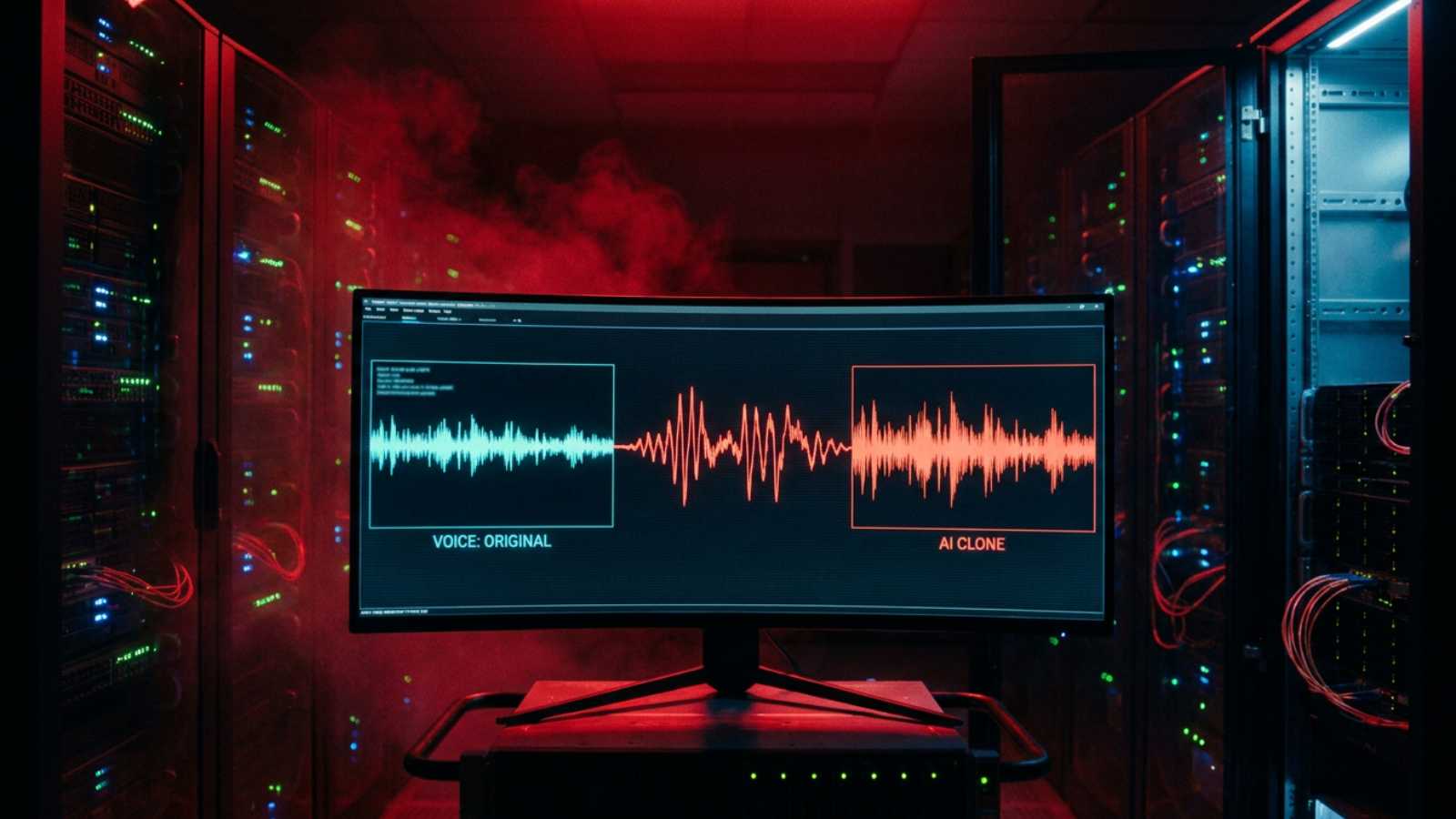
Google responded by launching an AI-based fake call detection system directly on Android. Not spam filtering based on a number blocklist, not simple keyword matching, but real-time acoustic signal analysis that runs completely on-device to detect signs that the voice on the other end of the call was generated by a machine, not human vocal cords.
How Google's Detection System Works
This feature is an expansion of the Scam Detection that Google previously introduced for Pixel phones. The initial version analyzed conversation patterns: whether the call content contained high-pressure tactics common in fraud scripts, such as claims that an account is being blocked, requests to purchase gift cards, or instructions to keep the call secret from family and colleagues.
The new layer being added now is acoustic analysis to detect AI-generated speech. The system examines several signal dimensions:
- Micro-timing artifacts: The distribution of time between phonemes in synthetic speech differs from the distribution in natural human speech. Generative models tend to produce statistically overly consistent rhythm.
- Formant transition patterns: Transitions between vowels in real human speech vary based on physical context such as tongue position and breathing pressure. Imperfect voice cloning produces transitions that are too "clean" or too regular.
- Noise floor signature: Human speech recorded under real conditions always contains background noise specific to the physical space. Synthetic audio often has a noise floor that doesn't match acoustic environment expectations.
- Codec interaction patterns: How synthetic speech interacts with telephone network compression codecs like
AMR-NBandOPUSdiffers from organic speech because of different frequency patterns at the micro level.
All this analysis is processed by Gemini Nano, a compact version of Google's AI model designed for inference on mobile devices. No audio is sent to Google servers during this process. Processing is entirely local.
When the system detects signs of synthetic audio, users get a real-time visual warning on their phone screen. The system does not automatically disconnect the call. Users remain in control of deciding what to do next, a deliberate design choice to avoid false positives that would be disruptive.
Deepfake Audio in the Real World: Anatomy of Attacks
That €220,000 case in England was not an anomaly. Over the past several years, the pattern of attacks based on voice deepfakes has been repetitive enough to categorize. There is a relatively clear taxonomy:
Business Voice Compromise (BVC) is a variation of Business Email Compromise that uses the voice channel. Attackers clone the voice of high-ranking executives like CFO or CEO, then call finance staff with urgent transfer instructions. Its success rate is higher than email-based BEC because voice is psychologically more authoritative and harder to "pause and verify" the way an email can be re-read.
Grandparent Scams exploit emotional relationships. Attackers clone the voice of a victim's child or grandchild from social media, then call the parents or grandparents with an emergency scenario: accident, arrested by police, need bail money immediately. This scheme is executed at scale in North America and is already included in official FBI advisories.
Bank Officer Impersonation uses public recordings of bank officers whose names are available on official websites, podcasts, or video conferences, then calls customers to request account verification or confirmation of "suspicious" transactions.
Two-Stage Compound Attacks are the most sophisticated. Deepfake audio is used as a component in multi-stage attacks: starting with spear phishing emails that psychologically prepare the target, followed by voice deepfake calls as "verbal confirmation" that makes the scam narrative feel more legitimate.
| Attack Type | Primary Target | Voice Cloning Source | Typical Loss Range |
|---|---|---|---|
| Business Voice Compromise | Corporate finance staff | Earnings calls, executive podcasts | $100,000 and up |
| Grandparent/Family Scam | Elderly individuals | Social media family members | $2,000 to $50,000 |
| Bank Officer Impersonation | Retail customers | Bank public video/audio | $5,000 to $100,000 |
| Two-Stage Compound Attack | C-suite, treasury teams | Combination of public media and spear recon | $500,000 and up |
| Real-time Deepfake in Video Conf | High-value executives | Recordings of previous meeting videos | Variable, potentially very large |
Industry Ecosystem: Who Else is Moving
Google is not the only actor, and the race to build defenses against deepfake audio is already underway on multiple fronts.
Apple has Neural Engine in A-series and M-series chips that have the hardware capacity to run similar on-device inference. So far Apple has not released an explicit deepfake audio detection feature in the Phone app, but iOS already integrates fraud signal detection for Messages and notifications. Regulatory pressure and direct competition with Google will likely accelerate Apple's steps in this area.
Microsoft is taking an enterprise approach through Azure AI and the Research division. Microsoft's research labs have published research on deepfake audio detection, and Azure Communication Services is already starting to incorporate fraud signal detection at the cloud infrastructure level. For corporations using Microsoft Teams as their primary communication platform, there is a relatively natural integration path to bring this detection into enterprise call workflows.
Qualcomm has an interest from the silicon side. Snapdragon chips that dominate the mid-to-high-end Android market have Hexagon NPU optimized for on-device AI inference. Qualcomm actively promotes this capability as the foundation for security use cases, and some Android OEMs are already designing NPU-based security pipelines as a differentiation selling point.
On the startup side, Pindrop has long offered enterprise solutions for detecting synthetic audio in banking and insurance contact centers. Resemble AI is developing audio watermarking systems that enable detection of synthetic content origins. ID R&D and Nuance, now part of Microsoft, have voice biometrics technology being adapted to detect spoofing and synthetic voice injection.
The most interesting direction going forward is cryptographic watermarking. Some researchers and industry groups are proposing systems where voice generative models are technically or regulatorily required to embed imperceptible watermarks in every audio they generate. Recipients or detection systems can then verify whether the audio contains a valid watermark. This is not a single perfect solution, but an additional layer that can work synergistically with real-time acoustic analysis like Google deploys.
An Arms Race That Never Ends
Deepfake audio detection is a classic adversarial problem: every improvement on the detection side sends an implicit signal to the research community and bad actors about which weaknesses have been closed. This drives iteration in generative models to close the gap.
Deepfake audio detection does not work like antivirus that can be updated with new signatures. It is more like an arms race where the defender must win every time while the attacker only needs to win once. Newer generative models will always produce fewer and harder-to-detect artifacts by systems trained on previous generations.
Some concrete challenges faced by Google and the entire ecosystem:
Generalization gap. Detection models trained on artifacts from a particular set of voice cloning tools may not generalize well to new tools that emerge months later. The velocity of innovation on the generative side is faster because market incentives are broader and more diverse from both commercial and open source community perspectives.
Compression-induced masking. Telephone networks use lossy codecs like AMR-NB, AMR-WB, EVS, and OPUS that remove most fine artifacts from audio signals during transmission. Detection systems must work on already-compressed audio, where synthetic and compression artifacts overlap and are difficult to separate.
Adversarial perturbation. Adversarial attack techniques well-established in computer vision have been adapted to the audio domain. With sufficient understanding of how the detection classifier works, attackers can add imperceptible perturbations to speech that actively guide the classifier output to bypass the warning threshold.
Alert fatigue and false positive calibration. This is a practical problem equally crucial to technical accuracy. Systems that are too aggressive will issue false warnings on legitimate calls such as people with poor audio quality, compressed VoIP connections, or speakers with uncommon voice characteristics. When users receive too many false warnings, they stop responding to warnings altogether. Systematically ignored alerts are as ineffective as no alerts.
Regulation, Privacy, and Gaps That Need Answering
3 major jurisdictions have already moved, though with different momentum and scope:
United States. The FCC has established that robocalls using AI speech without permission violate the Telephone Consumer Protection Act (TCPA). The FTC actively categorizes AI-based impersonation as fraud that can be prosecuted. Cross-border law enforcement remains a bottleneck, but the basic legal framework is in place.
European Union. The AI Act, which takes effect in phases, includes transparency requirements for AI systems that interact directly with humans. Clauses on "high-risk AI systems" could potentially be expanded to include voice cloning technology in commercial and criminal use contexts. Enforcement mechanisms will only become concrete in the coming years.
United Kingdom. The National Cyber Security Centre (NCSC) has already released specific guidance on deepfake fraud for enterprises. The Online Safety Act expands platform obligations to address deepfake content that causes harm.
From a privacy perspective, Google's choice of on-device processing is the ethically and design-wise correct position. But there are questions not yet explicitly answered: metadata from analysis such as whether certain calls are detected as synthetic, how often, from which source numbers, could become sensitive data in itself. How Google handles this metadata and whether terms of service explicitly cover it are questions relevant to privacy auditors and enterprise customers.
What most needs attention is the equity gap in protection access. Gemini Nano requires hardware capable of real-time inference. This means the feature will initially only be available on Pixel and flagship Android devices with the latest chips. Users in the low-end segment, who statistically are often targets of scams due to different risk profiles, get no equal protection. If Google wants this system to be truly universal protection and not just a premium feature, a roadmap to optimize for more modest hardware needs to be prioritized.
There are deeper structural questions: when on-device detection systems become good enough, should voice cloning generative models be regulated more tightly on the upstream side? Some countries are already examining mandatory watermarking for generative AI outputs, but global standardization does not yet exist. Without international coordination, regulation enforced by one jurisdiction can easily be circumvented by hosting models in jurisdictions that have not yet adopted similar standards.
Google's move clearly points in the right technical direction: placing AI as a response to AI, prioritizing privacy through on-device processing, and keeping humans as the final decision makers. Whether this architecture is sufficient to close the gap with velocity of generative model innovation, or whether effective protection can only be achieved through a combination of technical detection and stricter regulation at the global level, is a question whose answer will only become clear from real-world deployment at global scale over the next 12 to 18 months.
Share Article
Share
Disclaimer
All content presented in this article is for informational purposes only and should not be considered as financial advice. The author and publisher are not licensed financial advisors. Any investment decisions made by readers are personal choices, and all risks are solely borne by the reader. We strongly recommend conducting independent research and consulting with a licensed financial advisor before making any financial decisions.