Iran's Drone Attack on Kuwait Airport: A New Escalation in the US-Iran Retaliation Cycle

Drones Over Kuwait: A Single Attack That Changed the Gulf Calculus
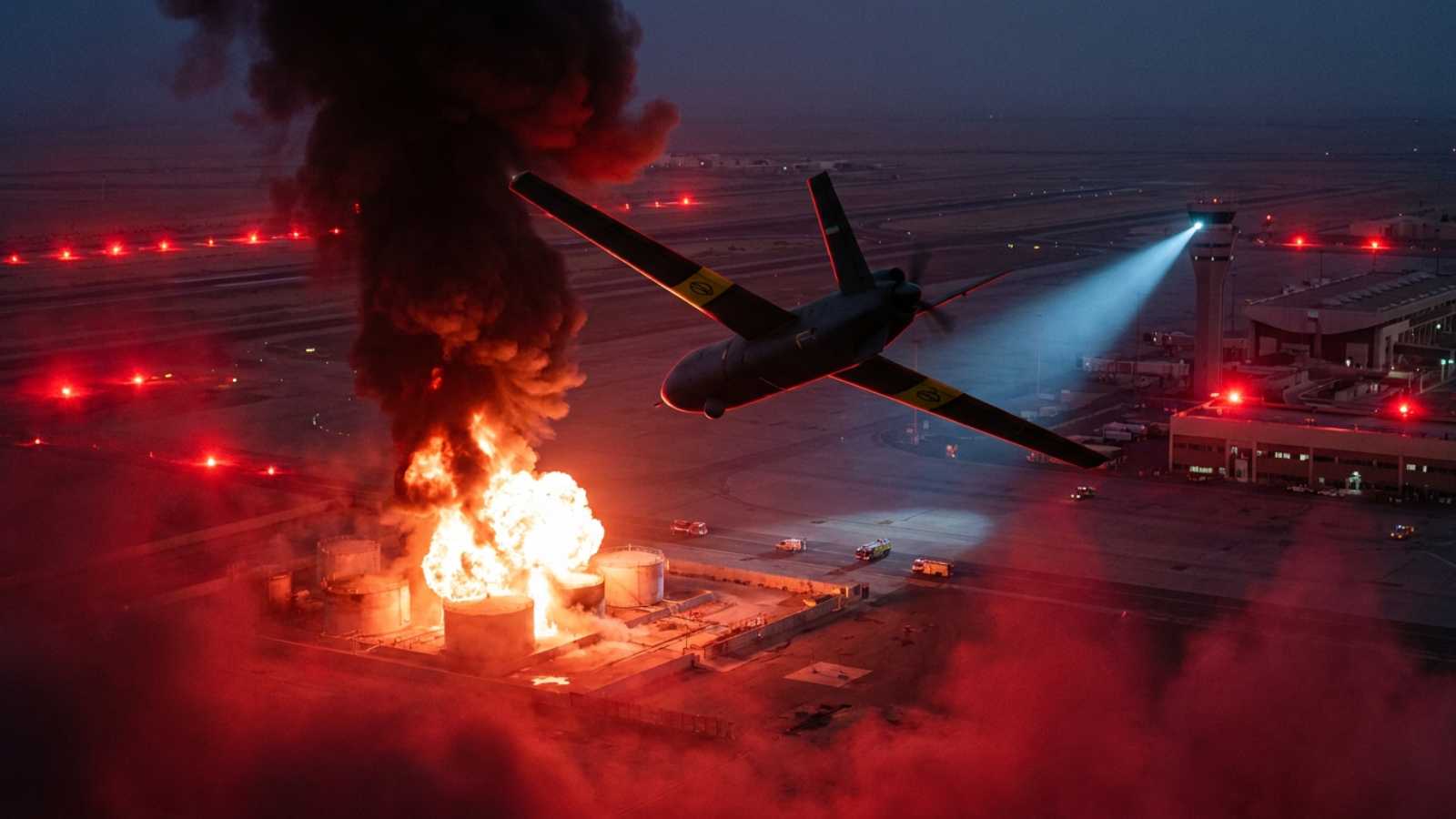
Iran launched a drone attack on Kuwait International Airport, and according to a BBC report dated June 4, 2026, this was no spontaneous action. The attack was a direct response to prior US military action against an Iranian oil tanker and an Iranian island. Both targets, the tanker and the island, are assets that under the Islamic Revolutionary Guard Corps (IRGC) doctrine historically demand a response that is visible and measurable.
But "measured" in this case means something different from usual.
Selecting Kuwait's civilian airport as the attack point was not merely a military response. It is a strategic statement: Iran is willing to place critical infrastructure of Gulf states that are US partners on its operational target list. Kuwait is not just a neighboring state. Within its borders lie two large-scale US military facilities: Camp Arifjan as a logistics and command hub, and Ali Al Salem Air Base as the primary landing point for US military personnel and materiel in the region.
That is what sets June 4, 2026 apart from previous escalations in the long cycle of Washington-Tehran confrontation.
The Architecture of Retaliation: A Cycle Running Long
Every confrontation between the US and Iran over the past 25 years has followed the same logic: action, retaliation, temporary silence, new action. This spiral does not end at a point of resolution because both sides never agreed on what constitutes "the first strike."
The sharpest precedent occurred in January 2020. The US killed General Qasem Soleimani in Baghdad. Iran responded by launching more than 10 ballistic missiles at US bases in Iraq, including Ain al-Assad in Anbar Province, causing dozens of US troops to suffer injuries. The US chose not to retaliate militarily. The cycle halted just before the threshold of full escalation, but that was not resolution. That was postponement.
Between 2020 and 2026, the pattern of retaliation continued through proxy channels. Houthis in Yemen attacked commercial ships and energy facilities in Saudi Arabia with drones and cruise missiles based on Iranian technology. Pro-Iran militias in Iraq attacked US bases dozens of times. On the other side, the US and Israel conducted cyber operations, assassinations of nuclear scientists, and destruction of Iranian strategic sites through channels never publicly claimed.
What changed is scale. According to BBC reporting, the US took direct action against an Iranian oil tanker and an Iranian island. Not through proxies, not through sanctions. Action that can be directly verified. And within IRGC doctrine, it demands a response that is also direct and verifiable.
Chronology of Escalation: From Maximum Sanctions to Kuwait Airport
This escalation did not emerge from a single incident. It is the accumulation of policy decisions over nearly a decade, each of which felt, at the time it was made, like a "measured" step.
It is worth noting that each phase in this chronology involves an expansion of scope. From economic sanctions, shifting to assassination of military figures, then to attacks on energy infrastructure, then disruption of global shipping lanes, and now to direct attacks on the civilian airport of a third country that is a US partner.
The pattern is not a straight line. It cycles, but each cycle is slightly wider than the last.
Kuwait Is Not a Random Target: Reading Iran's Strategic Message
Kuwait is a small country with an uncomfortable geopolitical position. To its north lies Iraq, where Iranian influence has been very strong since 2003. To its south lies Saudi Arabia. Within its own borders are the two US military facilities mentioned earlier, plus Kuwait International Airport, whose daily operations cannot be fully separated from overlapping military-civilian movements.
A drone attack on the civilian airport sends a message in several layers at once. First: "we can reach beyond direct US borders." Second: "US allies are legitimate targets in our calculations." Third, and this is the most troubling for the entire GCC: "no civilian infrastructure is automatically safe."
This message is not just for Kuwait. The United Arab Emirates hosts Al Dhafra Air Base. Bahrain is home to the US Fifth Fleet. Qatar hosts Al Udeid Air Base, the largest US military installation in the region. If an Iranian drone can reach Kuwait's airport, all GCC facilities adjacent to US assets are within the same radius.
The Strait of Hormuz and the Mathematics of Global Energy
Every time US-Iran tensions rise, one number always appears on energy analysts' tables: approximately 20 percent of global oil supply passes through the Strait of Hormuz daily. This narrow waterway between Iran and Oman is the most sensitive chokepoint in the planet's energy system.
A drone attack on Kuwait does not physically close the Strait of Hormuz. But it raises the risk premium on every ship passing through it. Maritime insurance companies will adjust their rates. Tanker fleet operators will reassess routes. Oil buyers in Europe, East Asia, and South Asia will accelerate purchases from reserve sources before conditions deteriorate further.
The global energy logistics system is already on alert even before this incident. Disruptions triggered by Houthis in the Red Sea since 2023 have forced many operators to avoid the Suez Canal and reroute around the Cape of Good Hope, significantly adding cost and shipping time. When the Red Sea is disrupted and the Strait of Hormuz faces pressure simultaneously, the remaining buffer for maneuvering shrinks to almost nothing.
Oil markets react not only to actual disruptions. They react to the possibility of disruption. The risk premium built into oil prices can exceed the physical impact of the incident itself. The Kuwait airport attack is a signal, not merely a military operation.
The large oil-importing nations most affected are those whose dependence on Gulf oil is very high and which lack adequate long-term strategic reserves.
| Country/Bloc | Est. Gulf Oil Dependence | Strait of Hormuz Exposure | Risk Level |
|---|---|---|---|
| Japan | ~85-90% of total oil imports | Very High | Critical |
| South Korea | ~70% of total oil imports | Very High | Critical |
| India | ~60-65% of total oil imports | High | High |
| China | ~45-50% of total oil imports | High | High |
| European Union | ~25% of total oil imports | Moderate | Manageable |
Percentages are estimates based on historical IEA data, Japan's METI, and Korea's KNOC. Not specific figures from the BBC source referenced in this article.
The GCC Between Two Fires: Solidarity Versus Interest
There is no more complicated position in this escalation than that of the GCC states. Kuwait must respond to an attack on its own civilian airport, but how it responds determines whether it becomes the next battlefield.
Saudi Arabia and the United Arab Emirates face a difficult dilemma. Both, in recent years, have gradually moved toward Iran through normalization framed by China's mediation in 2023, rebuilding diplomatic relations that were once broken. GCC solidarity pushes them to stand with Kuwait. But the diplomatic investment already built with Tehran makes them reluctant to get more deeply involved, especially when the root of this conflict involves US military action that is not a GCC initiative.
Qatar faces an even more complicated situation. It has significant economic ties with Iran, including joint ownership of the South Pars/North Dome gas field, the world's largest natural gas field. Full confrontation between the US and Iran directly threatens Qatar's largest strategic asset and its position as one of the world's leading LNG exporters.
Bahrain, where the US Fifth Fleet is based, is de facto on the front line of risk if escalation spirals out of control. Security concerns within Bahrain itself, with a Shiite-majority population and a history of sectarian tensions, add a separate layer of risk.
There is no scenario in which the GCC can respond to this escalation with a single coherent voice. This is not merely a GCC diplomatic weakness. It reflects how intricate the cross-cutting interests are in this region, even among states that are formally allied.
The Nuclear Dimension: Layered and Mutually Reinforcing Pressures
The drone attack on Kuwait occurs in a larger context that cannot be ignored: Iran's nuclear program, which has sat at a critical threshold for years. Since the US withdrew from the JCPOA in 2018, Iran has gradually released itself from the agreement's commitments and advanced uranium enrichment beyond agreed limits.
Western intelligence has repeatedly warned that Iran is within months, not years, of the capability to produce a nuclear device if it chooses to do so. This is where the dynamics become extremely dangerous.
The more militarily cornered Iran becomes, the greater the internal incentive to accelerate the nuclear program as a regime-existence deterrent. But the closer Iran comes to nuclear capability, the greater the pressure on the US and Israel to conduct preventive military strikes before that threshold is crossed. These two pressures move in opposite directions and accelerate each other.
US conventional attacks on an Iranian oil tanker and island, which triggered the drone response on Kuwait, reinforce the internal narrative in Tehran that without a nuclear deterrent, Iran is always vulnerable to direct US action. This calculation, more than anything else, is the most difficult to interrupt from outside.
Why Drones, Why Now: Weapon Choice That Is No Coincidence
Iran has built substantial drone capabilities over the past decade. The Shahed series drones, particularly the Shahed-136, received global attention after Russia used them massively in Ukraine since 2022. Before that, the Houthis demonstrated the effectiveness of saturation drone tactics against Saudi Aramco facilities in 2019. Iran learned from both, while also supplying its technology to others.
The choice of drones as the instrument of retaliation is not the result of weapons limitations. Iran possesses ballistic missiles with far greater precision. Drones were chosen for specific tactical and strategic reasons:
- Early interpretive ambiguity: It takes time to confirm the origin and operator of a drone attack, giving Iran a diplomatic window to frame its public response.
- Asymmetric cost-impact: A single drone landing in the airport area produces disruption disproportionate to its relatively low production cost.
- Scalability: Easy to mass-produce, easy to operate by proxies or directly, requires no large launch platform easily detected.
- Difficult to fully intercept: Modern air defense systems are designed for ballistic missiles and conventional aircraft. Saturation with dozens of small drones at once strains any system, including the sophisticated systems operated by the US in the Gulf.
The Houthis proved the effectiveness of this tactic in the Red Sea since 2023, and Iran as the primary supplier of that drone technology has observed and documented the results in detail.
Spiral Risk and the Path Toward Broader Conflict
The most relevant question on June 4, 2026 is not whether this attack occurred. It did. The question is where the next step leads.
The US has several response pathways, each carrying radically different consequences:
Minimal response, consisting of condemnations, enhanced sanctions, and added defensive assets, signals that Iran can attack US allies without direct military consequences. This signal encourages the calculation that further escalation is also tolerable.
Limited response, that is, precision strikes on one Iranian target that is "militarily equivalent," shows US willingness to retaliate, but risks triggering the next round of retaliation at a scale not easily predicted.
Large response encompassing Iranian military or nuclear facilities transforms the conflict from limited escalation into potential full regional war, with implications for all of the GCC, global energy markets, and geopolitical stability far beyond the Persian Gulf.
The middle option, most difficult of all, is to demonstrate enough strength to make Iran stop without triggering full war. Iran is playing similar calculations on its side of the table.
What is clear from this historical pattern: retaliation spirals do not lead to de-escalation organically. Each action demands an expected response from the other side. Each response creates justification for the next action. Without effective back-channel communication, or third-party diplomatic pressure like China has due to its large economic interests on both sides, this spiral has no natural brake.
The Persian Gulf in June 2026 is at its most volatile point in a generation. The drone attack on Kuwait is not the crisis's peak. It is one of its most dangerous midpoints, because it opens a new precedent about what can become a target in a conflict that is formally not yet called war.
Share Article
Share
Disclaimer
All content presented in this article is for informational purposes only and should not be considered as financial advice. The author and publisher are not licensed financial advisors. Any investment decisions made by readers are personal choices, and all risks are solely borne by the reader. We strongly recommend conducting independent research and consulting with a licensed financial advisor before making any financial decisions.