Iran Threatens Strait of Hormuz Blockade: Tehran Halts US Talks, Oil Prices Surge 8%

June 3, 2026: Tehran Halts Negotiations, Oil Prices React Immediately
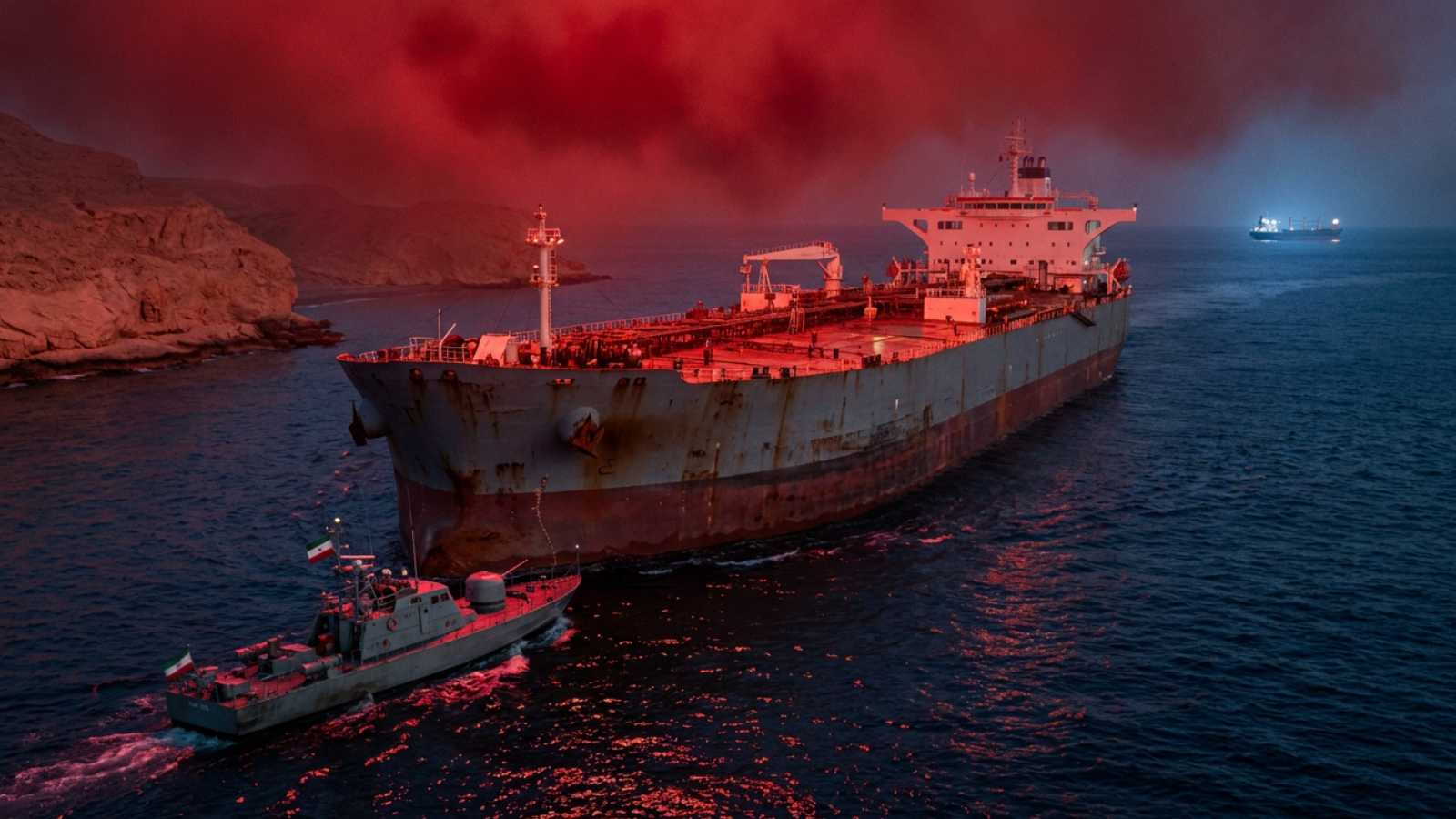
On Wednesday, June 3, 2026, Iran's government formally announced the halt of peace talks with the United States. More than just stopping negotiations, Tehran simultaneously issued threats that shook global energy markets: Iran stands ready to "fully blockade" the Strait of Hormuz and the Strait of Mandeb if pressure from Washington continues.
Oil markets reacted within minutes. West Texas Intermediate (WTI) crude surged to $94.20 per barrel. Brent Crude pierced $97.23 per barrel. This increase reflected a jump of around 8% in a single trading session, one of the sharpest daily moves for the commodity in recent years.
This is not mere routine diplomatic rhetoric.
Two Straits, One Choke Point in Global Energy
The Strait of Hormuz is a narrow gateway connecting the Persian Gulf to the Indian Ocean. At its narrowest point, it spans roughly 33 kilometers. Through this gap, the bulk of crude oil exports from Saudi Arabia, the United Arab Emirates, Kuwait, Iraq, and Iran itself must pass daily. Based on data that has become the standard reference for the global energy industry, the Strait of Hormuz is estimated to handle roughly 20% of all global oil trade, making it one of the most critical bottlenecks in this planet's energy system.
The Strait of Mandeb, located at the southern tip of the Red Sea between Yemen and Djibouti, is explicitly mentioned in Tehran's threat. This strait is the gateway to the Suez Canal. LNG from Qatar and oil from Persian Gulf producers bound for European markets pass through this route. Disruption at Mandeb means vessels are forced to detour via the Cape of Good Hope in southern Africa, adding weeks of transit time and considerable logistics costs.
If Iran truly closes either one of these, the impact extends far beyond the numbers on traders' screens. This would trigger an energy logistics crisis unlike any the world has faced on this scale since the 1973 OPEC embargo.
Market Reaction: Numbers That Cannot Be Ignored
WTI $94.20 per barrel. Brent $97.23 per barrel. An 8% jump in a single trading session.
Behind every dollar of crude price increase lies implications felt at gas pumps in Tokyo, in electricity bills for households in Frankfurt, in operating costs for airlines in Dubai, and in profit margins for manufacturing plants in Guangzhou.
An 8% jump in one day signals that markets do not view Iran's threats as empty bluffing. This is a collective assessment by thousands of market participants weighing the probability of actual supply disruption.
When Iran mentions the Strait of Hormuz in the same sentence as the word "blockade", markets immediately calculate worst-case scenarios. This is a reflex programmed over decades of Persian Gulf crises. Geopolitical risk premiums do not wait for verification; they move faster than facts on the ground.
For context: before the June 3, 2026 announcement, negotiations between Tehran and Washington had briefly offered hope that tensions might ease. The halt of talks, followed by explicit threats to blockade 2 straits simultaneously, forced traders and analysts to shift their positions within hours.
Dependency Map: Who Is Most Exposed
Not all global oil consumers face the same position in confronting this threat. The degree of dependence on the Hormuz route and availability of alternatives determine how severely a country would be impacted if a blockade actually occurs.
| Country/Region | Dependence on Hormuz Route | Available Alternatives | Risk Level |
|---|---|---|---|
| Japan | Very high, majority of imports from the Gulf | Very limited, strategic reserves have time limits | Critical |
| South Korea | Very high, over 60% of imports from the Gulf | Limited, diversification still in stages | Critical |
| China | High, the Gulf is the largest supplier | Some via land pipelines from Russia | High |
| India | High, large imports from Saudi, Iraq, UAE | Some can be diverted to other producers | High |
| European Union | Medium to high, depends on member state | Alternatives via pipelines and LNG terminals | Medium |
| United States | Low, high domestic shale oil production | Strategic reserves (SPR) and local production | Low |
The United States sits in the most comfortable position supply-wise. Domestic shale oil production makes the US far less dependent on Persian Gulf imports than it was two decades ago. But that does not mean the US is immune to price shocks, because oil is a global commodity priced in international markets. WTI increases will be felt in the US itself.
Japan and South Korea sit at the most vulnerable end. There are virtually no alternative pipelines, strategic reserves have time limits, and both economies are extremely energy-intensive. If Hormuz closes even for a few weeks, both nations will face pressure that cannot be addressed by reserves alone.
China has slightly more options, including oil supplies from Russia via land routes. But the volume that can flow through the Russia-China pipeline falls far short of Beijing's total needs, so dependence on sea routes remains highly substantial.
Why This Threat Differs from Previous Crises
The threat to blockade the Strait of Hormuz is not new in Iran's diplomatic lexicon. Tehran has previously invoked such threats as a negotiating card when international pressure rises. What makes the situation on June 3, 2026 different is a combination of factors occurring simultaneously.
First, Iran's announcement is not merely freezing talks; it explicitly names 2 straits at once: Hormuz and Mandeb. Mentioning Mandeb adds a new dimension because it signals Iran is prepared to activate its network of influence in Yemen, given that the Strait of Mandeb lies within the reach of groups operating in that region with ties to Tehran.
Second, the timing of this announcement arrives when energy markets are already tense from various other geopolitical pressures. Layered tensions amplify every new signal.
Third, there are no signals from Washington that a new offer is being prepared to bring Tehran back to the negotiating table in the near term.
Full Blockade vs. Partial Disruption: What's More Likely
Some analysts argue Iran would not fully close the Strait of Hormuz because the country itself exports oil through the same route. A complete blockade would hurt Tehran as much as anyone else. This argument makes sense from a rational economic perspective.
But that logic overlooks one critical variable: if Iran feels it has little more to lose under maximum sanctions pressure, that rational calculation could shift. A country already economically isolated has different risk tolerance for what is normally considered unthinkable.
A middle option is more plausible than total blockade. Partial disruption could take various forms: attacks or threats against tankers in the region, temporary closure of certain navigation lanes, or activation of proxy groups at Mandeb to raise maritime insurance costs to levels that make the route economically unfeasible for many commercial operators. These are all methods that do not require direct military action from Iran itself, but their market impact could be as dramatic as physical blockade.
Maritime insurance markets have already responded even before any physical action. Premiums for tankers transiting the Persian Gulf region spiked immediately after the June 3, 2026 announcement. The insurance premium increase alone is enough to push some operators to reconsider their routes or renegotiate shipping contracts.
Positions of the Major Players: Who Moves, Who Waits
Geopolitical Calculations After June 3, 2026
Direct party in talks frozen by Iran. The US Fifth Fleet based in Bahrain has strong regional presence, but direct military response carries consequences far beyond the strait issue. Diplomatic pressure via regional allies becomes the initial option.
Controls the narrative after the June 3, 2026 announcement. The threats to blockade Hormuz and Mandeb are the highest cards available, but playing them fully also halts Iran's own oil exports.
The largest Persian Gulf oil consumer and a significant trading partner of Iran. Unique diplomatic leverage that no other actor possesses. Beijing does not want supply instability, but also does not want the US to resolve this crisis unilaterally.
Dependent on Hormuz for their own oil exports. Economic interest is clear: the strait must remain open. But the diplomatic position is more complex given the shifting regional relationship dynamics with Tehran in recent years.
When oil prices jump 8% in a day and strait blockade threats circulate, the response from major global actors becomes the next decisive variable. Washington faces a choice between de-escalation that might appear as concession, or a response that risks dramatically worsening the situation.
China, as the largest consumer of Gulf oil and possessing significant economic ties to Tehran, holds diplomatic leverage that no other actor commands. Beijing does not want energy supply disruption, but also does not want the US to resolve this crisis unilaterally and entrench American dominance in the region. Beijing's position in this situation will be crucial in determining how long and how far this escalation can proceed.
Systemic Risk: More Than Just Numbers at the Pump
The greatest danger from this scenario is not merely near-term oil price spikes. Price increases, however painful, can be absorbed by the global economy with difficulty. The deeper danger is erosion of confidence in the reliability of the global energy supply system built over decades on one fundamental assumption: that these strategic straits will always remain open for commercial navigation.
If that assumption breaks, the consequences are structural and long-term. Energy-importing nations will be forced to accelerate supply diversification, build larger strategic reserves, and prioritize renewable energy transition not just for climate reasons but for concrete national security reasons. Global industrial supply chains assumed to run smoothly will be fundamentally reconsidered.
At the same time, oil producers outside the disputed zone gain a new windfall. US shale oil, Canadian, and Brazilian crude suddenly become more attractive to importers seeking to reduce geopolitical exposure, regardless of production cost differentials.
Liquefied natural gas (LNG) markets are also affected. Qatari LNG passing through the Strait of Mandeb bound for Europe will face different disruption than crude, but no less serious for European nations still building diversification away from Russian gas dependence.
In the near term, the International Energy Agency (IEA) and strategic reserve coordination mechanisms among member states will be the first tools activated if the situation deteriorates further. Strategic reserves are designed as a time bridge, not a permanent replacement for functioning supply systems.
One day's announcement, 2 straits under threat, and an 8% surge in global oil markets. What stands at stake on June 3, 2026 is not merely refinery margins or transportation budgets. What stands at stake are the fundamental assumptions undergirding the architecture of global energy security that has been taken as permanent but proves fragile at certain points that are extremely narrow geographically.
Share Article
Share
Disclaimer
All content presented in this article is for informational purposes only and should not be considered as financial advice. The author and publisher are not licensed financial advisors. Any investment decisions made by readers are personal choices, and all risks are solely borne by the reader. We strongly recommend conducting independent research and consulting with a licensed financial advisor before making any financial decisions.