Kim Jong Un Visits New Uranium Facility: North Korea's Nuclear Program Escalation and Its Implications

New Facility, Old Ambitions Accelerated
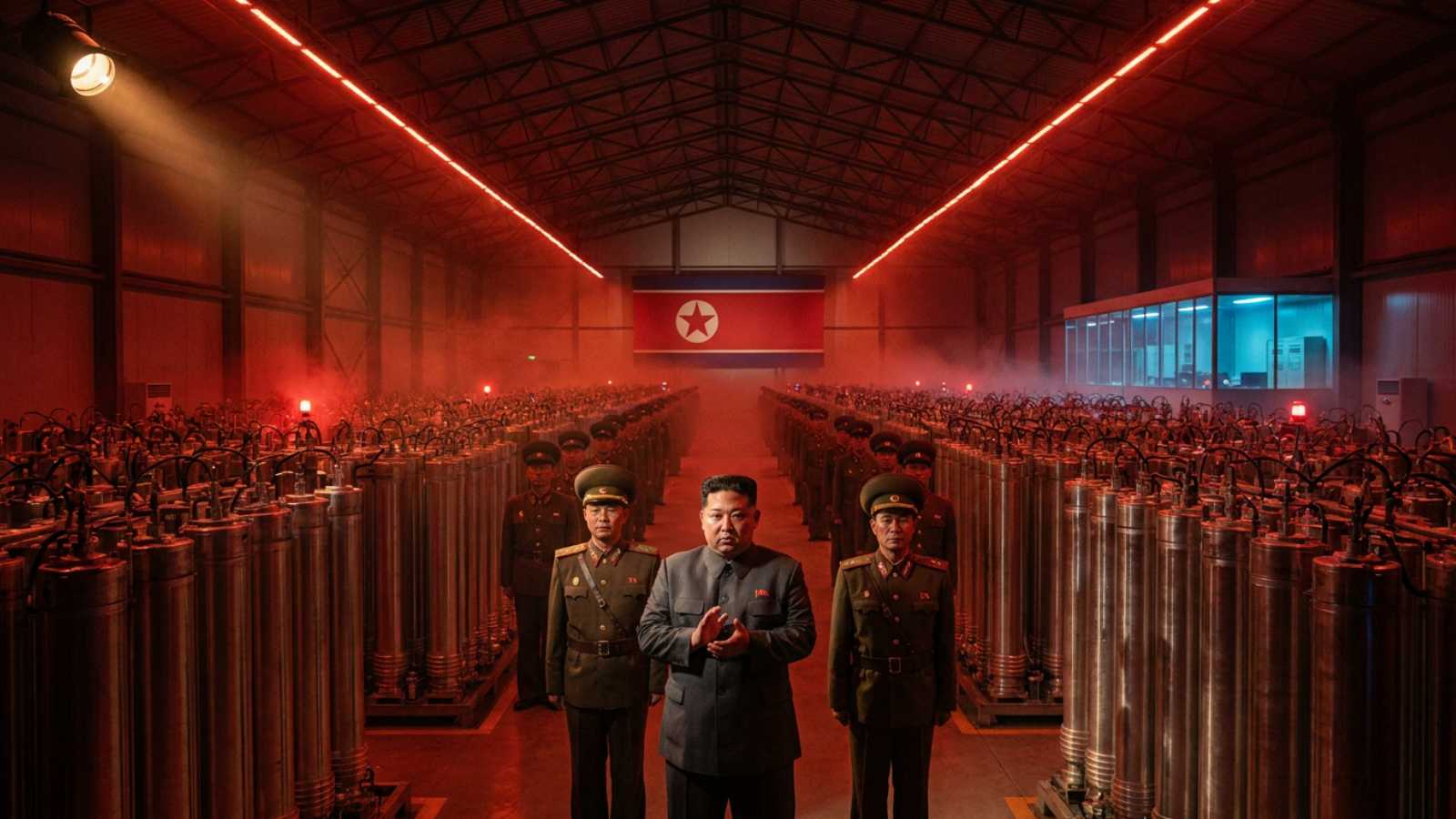
State media photos released by North Korea on June 4, 2026 needed no contextual translation. Kim Jong Un stood among large-scale industrial installations: rows of production equipment, uniformed technicians, and direct inspection of machinery that was clearly not for civilian use. Pyongyang's state media confirmed it themselves: this was a new weapons-fuel nuclear production facility, designed specifically to produce weapons-grade uranium.
Kim Jong Un's visit to such a facility is no administrative routine. In Pyongyang's logic of political communication, a top leader's visit to strategic military-industrial installations always signals concrete escalation in national priority. This is not a photo opportunity; this is a policy declaration packaged in images deliberately selected for simultaneous domestic and international consumption.
What Weapon-Grade Uranium Means
Natural uranium contains roughly 0.7 percent of the U-235 isotope, the isotope capable of driving a chain fission reaction. Civilian power reactors require enrichment of 3 to 5 percent. Weapon-grade uranium requires U-235 concentration above 90 percent. The leap from 5 percent to 90 percent is not a difference of degree; it is a difference of category in infrastructure, technology, and intent.
This enrichment process is carried out through high-speed centrifuges spinning in cascade configuration. This technology can be installed underground, disguised as a normal industrial facility, or hidden within existing military complexes. That is what makes verification of such programs so technically difficult, now or before.
What is most significant about the June 4, 2026 announcement is the word "new." North Korea already possesses the Yongbyon complex, known to the international community since the 1990s. The existence of a separate additional facility indicates a deliberate dispersal strategy: spreading production capacity across multiple locations so that a precision strike or diplomatic pressure against one facility cannot sever the entire chain of nuclear production.
Timeline of Escalation: A Program That Never Really Stopped
North Korea first claimed nuclear status after an underground test in 2006. Five subsequent tests formed a consistent escalation curve, with the 2017 test producing the strongest explosion in the program's history, accompanied by a hydrogen bomb claim that, while technically debated, still marked a significant capability leap.
Between 2018 and 2019, there was a narrow window of diplomacy that briefly offered hope. Kim Jong Un met Donald Trump twice: in Singapore and Hanoi. The Hanoi talks ended without agreement because of fundamental disagreement over sequencing. Washington wanted denuclearization first before substantial sanctions relief; Pyongyang wanted real sanctions relief before any denuclearization steps began.
After 2019, North Korea gradually abandoned the moratorium that Kim Jong Un himself had announced. In 2022, a series of missile tests resumed, including a new ICBM. In 2024, a constitutional revision locked North Korea's nuclear status as permanent, not a negotiating position. The facility Kim Jong Un visited on June 4, 2026 is the logical continuation of that trajectory.
Key Actors and Their Positions
Each North Korean escalation triggers responses following a predictable pattern, but that does not mean the structural analysis is any less important.
| Actor | Official Position | Core Interests | Pressure Instruments |
|---|---|---|---|
| United States | Complete denuclearization before normalization | Alliance deterrence, global nonproliferation | Sanctions, military presence, extended deterrence |
| South Korea | Phased denuclearization with diplomatic engagement | National security, peninsula stability | Dialogue, coordinated sanctions, US military coordination |
| Japan | Elimination of nuclear and ballistic missile programs | Protection from direct missile threat | Diplomatic pressure, trilateral alliance participation |
| China | Korean Peninsula stability, no nuclear weapons in the north | Prevent border instability, constrain additional US military assets | Economic leverage as NK's dominant trading partner |
| Russia | Regional stability aligned with its own geopolitical interests | Counter US influence in East Asia | Bilateral relations, avoidance of multilateral sanctions |
| North Korea | Maintain nuclear capability as regime survival guarantee | Survival of Kim Jong Un regime | Military threat, intermittent diplomacy |
China holds the most complex position among all actors. Beijing officially supports Korean Peninsula denuclearization, but operationally has never been willing to pressure Pyongyang to the point of threatening regime stability. For Beijing, a weak but nuclear-armed North Korea is more tolerable than a collapsed North Korea generating massive refugee flows, or worse, Korean reunification under the umbrella of a US military alliance.
Impact on Asia-Pacific Security Architecture
The inauguration of this new uranium facility does not merely shift military balance. It alters deterrence calculations across the region in 3 dimensions simultaneously.
First, the question of US extended deterrence becomes increasingly acute. Extended deterrence refers to the US commitment to use its nuclear capability to protect allies like South Korea and Japan if needed. As North Korea expands its nuclear weapons production capacity, the credibility question becomes louder: will Washington truly risk nuclear conflict for Seoul or Tokyo when American cities themselves are within range of North Korea's ICBMs?
Second, the debate over independent nuclear capability gains resonance. In Seoul, voices supporting the development of South Korea's own national nuclear weapons, historically suppressed by Washington, gain more public support each time Pyongyang displays progress in its nuclear program. Similar dynamics apply in Tokyo, though in a different constitutional context and with stronger political constraints.
Third, the expansion of North Korean capability affects the overall US military posture in the region. The rotation of strategic assets, deployment of missile defense systems, and trilateral intelligence coordination between the US, South Korea, and Japan all experience increased intensity with each new Pyongyang escalation.
Denuclearization Negotiations: Why Diplomatic Channels Remain Blocked
Complete and verifiable denuclearization of North Korea remains the stated policy objective of the United States and its alliance partners. But without agreed verification mechanisms and proportional incentives, that stated objective has no realistic implementation path under current geopolitical conditions.
Denuclearization negotiations consistently stall at 2 identical points: who moves first, and who verifies the step.
North Korea consistently rejects the Libya model, where denuclearization occurred before international normalization. For Pyongyang, the Libya model ended with the overthrow of Muammar Gaddafi after the country surrendered its weapons program to the West. Kim Jong Un has explicitly referenced this pattern as justification for why North Korea will never follow the same path.
The United States and its alliance partners, on the other hand, refuse to grant significant economic concessions or security guarantees without actual verification of denuclearization steps. Past experience, including the collapse of the 1994 Agreed Framework, makes Washington skeptical of verbal commitments without binding and enforceable inspection mechanisms.
Between these two positions there is no easy middle ground. CVID, Complete Verifiable Irreversible Denuclearization, which has become the formal standard of international demands, currently has no realistic implementation path in the short or medium term horizon.
This dynamic creates a difficult-to-break circle. Each North Korean escalation triggers new sanctions; sanctions that are not fully effective drive North Korea to continue developing its nuclear program as a strategic bargaining instrument; and a more advanced program makes initial concessions to open dialogue increasingly costly politically for all parties involved.
China's Role and Sanctions Evasion Dynamics
International sanctions against North Korea, reinforced through various UN Security Council resolutions, theoretically should cut Pyongyang's access to the technology, materials, and finance needed for its weapons program. In practice, the effectiveness of these sanctions continues to erode.
China is North Korea's dominant trading partner. How hard Beijing enforces sanctions in the energy, food, and manufacturing sectors directly determines the real economic pressure Pyongyang experiences. When China chooses not to fully enforce sanctions, reflected in various reports of continuing cross-border trade, North Korea's economic space remains sufficient to sustain priority military programs.
Since 2022, this dynamic has been complicated by North Korea's growing closeness to Russia in the context of the ongoing conflict in Eastern Europe. Intelligence reports from various sources indicate transfers of military materiel from Pyongyang to Moscow, believed in exchange for various forms of technology support and reduced international pressure. Whether nuclear or missile technology transfers are included in this bilateral transaction remains a question continuously investigated by defense analysts from various institutions, including IISS and 38 North.
The combination of implicit Chinese support and a new relationship with Russia leaves the multilateral sanctions framework that has been the main pillar of the international pressure strategy against North Korea facing structural erosion that is increasingly difficult to reverse.
Verification Challenges in an Era of Dispersed Capacity
One thing that makes confirmation of this new facility most alarming from a technical perspective is what the international community did not know beforehand. If this facility only came to light through Kim Jong Un's official visit published by state media, the immediate question is: how many similar facilities might be operating without ever being revealed?
The Yongbyon complex became the focus of denuclearization talks for years because that is what the international community knew about. North Korea even invited inspectors and discussed Yongbyon as part of various rounds of negotiation. But if Pyongyang's actual strategy is to build backup capacity at various publicly unknown locations, then concessions over Yongbyon alone no longer represent actual denuclearization, only convenient symbolism for parties wanting to claim diplomatic progress.
This is a paradigm shift in the negotiation context that cannot be ignored. Verifiable denuclearization requires complete declaration of all facilities, followed by unlimited and continuous inspection access. North Korea has never provided such a declaration, and with this new facility confirmed on June 4, 2026, the true scale of the verification challenge becomes clearer to all parties.
Analysts from institutions like IISS and 38 North consistently emphasize that public assessment of North Korea's nuclear program is always partial because of intelligence access limitations. Kim Jong Un's June 4, 2026 visit is a reminder that there is a substantial segment of the program deliberately hidden until Pyongyang itself decides to reveal it, according to its own strategic communication agenda.
Risk Calculation: Shift from Deterrence to Active Posture
There is an important distinction between possessing nuclear weapons as a deterrence instrument and possessing them as an active operational option. So far, the dominant assumption in the international security community has been that North Korea views its nuclear weapons as a regime survival guarantee, not as an offensive weapon meant to be actively used in conflict.
In 2022, North Korea revised its law on nuclear weapons use to explicitly permit preemptive strikes under certain conditions determined by leadership. This is not empty rhetoric; this is a formal doctrine change that was published and must be taken seriously.
The new uranium facility confirmed on June 4, 2026 strengthens the production capacity for material needed to expand the arsenal quantitatively. A larger arsenal, in North Korean military logic, means more operational flexibility. This includes the ability to allocate a number of warheads for specific missions without exhausting the entire deterrence capacity.
This shift is what makes analysts from Seoul to Washington to Tokyo uncomfortable. It is not just the existence of North Korea's nuclear weapons that is the primary concern, but the trajectory of quantity, technical capability, and use doctrine that increasingly feels like a transition from minimal deterrence to a more expansive and operationally active nuclear posture.
The question that remains unanswered after June 4, 2026 is whether there will be a diplomatic response or new pressure substantial enough to change Pyongyang's calculation. Based on the pattern of the last 2 decades, the answer will not come from sanctions alone.
Share Article
Share
Disclaimer
All content presented in this article is for informational purposes only and should not be considered as financial advice. The author and publisher are not licensed financial advisors. Any investment decisions made by readers are personal choices, and all risks are solely borne by the reader. We strongly recommend conducting independent research and consulting with a licensed financial advisor before making any financial decisions.