Marvell Technology Surges 24% After Jensen Huang Calls Semiconductor Next Trillion-Dollar Company Candidate

When One Comment Moves Billions of Dollars
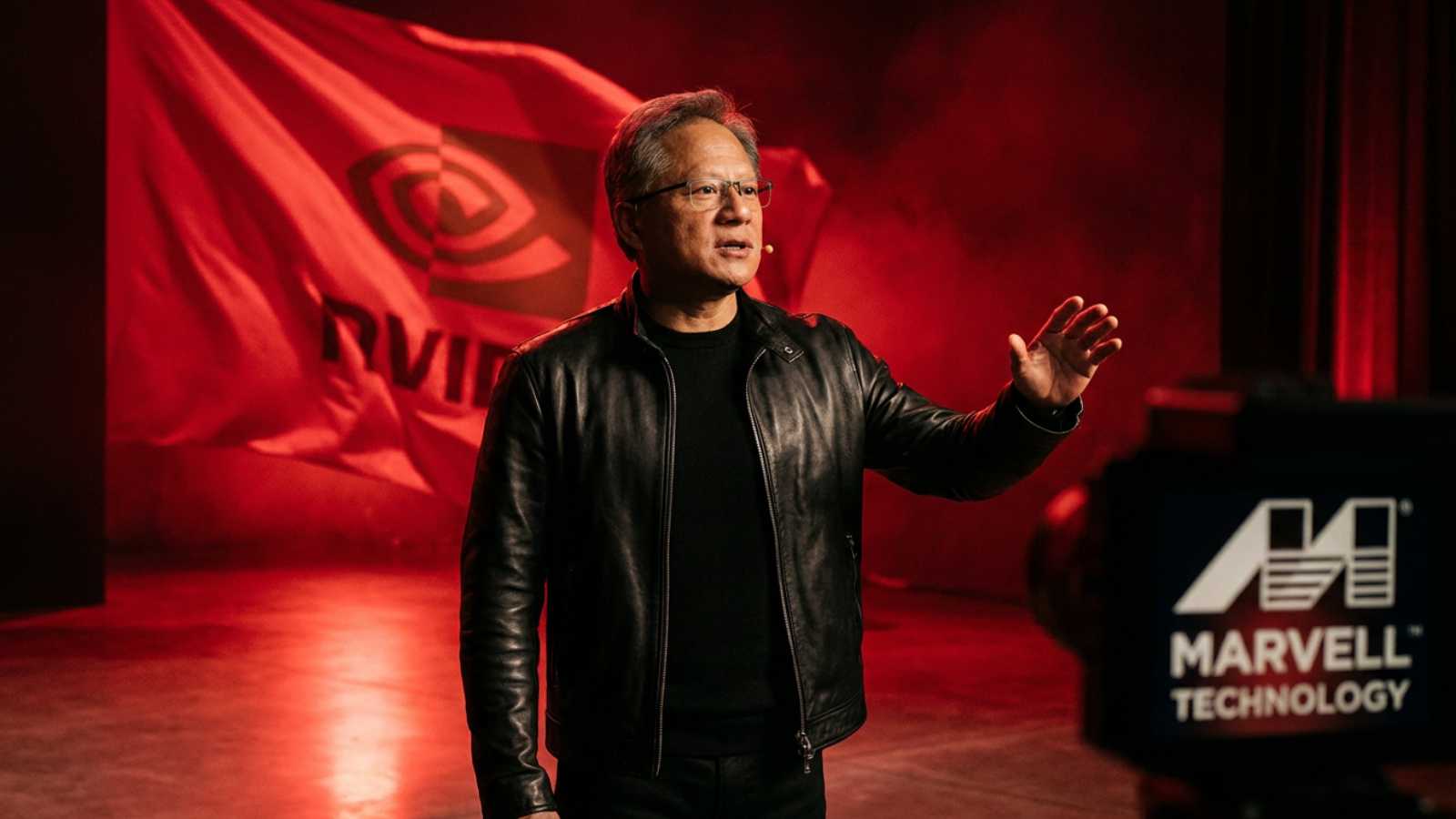
A 24 percent move in premarket trading is not routine. Before the New York market officially opened Wednesday morning (6/3), Marvell Technology stock had moved that far, triggered by one thing: Jensen Huang's comment about the massive potential of semiconductors as the engine of growth for the next trillion-dollar company.
Bloomberg reported in its June 2 market wrap that Huang, Nvidia's CEO, called the chip sector the strongest candidate to produce a company valued at $1 trillion or more. Not fintech, not consumer platforms, not biotech. Semiconductor.
For investors tracking this industry, this is not simply an optimistic statement from an executive. It is a signal from the person leading the first chip company to breach a $3 trillion valuation, and more importantly, from someone who receives purchase orders directly from the world's largest hyperscalers. Huang speaks from data, not speculation.
The market responded accordingly. Marvell became the most highlighted stock. A broader rally in the AI semiconductor ecosystem rolled forward, with Bloomberg noting that this positive sentiment also drove potential gains in Asian stock markets that correlated with the same theme.
Why Marvell, and Why Now
Marvell Technology is not a new player, but it spent years living in the shadow of bigger names. Its core business is custom ASIC (application-specific integrated circuit) and networking chips for data centers. A solid segment but not sexy narratively for the market.
All that changed when AI infrastructure demand started fundamentally reshaping how hyperscalers build their compute stacks.
General-purpose GPU like Nvidia's products are powerful for training AI models, but not always most efficient for large-scale repeated inference workloads. Once a model is trained and must serve billions of queries per day, the unit economics of a chip designed specifically for one type of task become far more attractive. Custom ASIC offers better performance per watt and cost per token for certain workloads compared to standard GPUs.
This is where Marvell enters. They have the capability to co-design custom chips with hyperscalers, build networking silicon that connects thousands of chips inside a data center, and support the infrastructure scalability that AI needs at every layer.
When Huang called semiconductor the best ground for the next trillion-dollar company, investors immediately read this business profile: custom AI silicon, strong position in data center networking, and direct exposure to hyperscaler capex still in a growth cycle.
"Second Tier" Ecosystem No Longer a Backup
For years, the AI chip narrative was heavily concentrated on one name. CUDA ecosystem, H100, H200, Blackwell, all dominating the conversation. Other companies in this ecosystem, however solid their business, lived in that giant's shadow.
Huang's statement changed the framing. Not because he diminished Nvidia, quite the opposite. But because he explicitly opened space that there is more than 1 trillion-dollar story in this industry, and the market immediately responded by searching for the next candidate.
This makes structural sense. The total addressable market for AI infrastructure is not zero-sum. The more companies build AI models, the more data centers are built, the more different chips are needed: training chip, inference chip, networking chip, memory chip, edge chip. Nvidia leads in training GPUs, but the entire ecosystem layer around it also grows at an equally rapid pace.
| Company | Primary AI Focus | Supply Chain Position | Type of AI Exposure |
|---|---|---|---|
| Marvell Technology | Custom ASIC, Networking Silicon | Hyperscaler ASIC co-design, Data center fabric | Direct via custom chip order |
| Broadcom | Custom AI Accelerator, Networking | Hyperscaler ASIC, large volume | Direct, enterprise scale |
| Micron Technology | HBM, DRAM, NAND | Memory for training & inference chips | Critical memory infrastructure |
| TSMC | Advanced node foundry | Manufacturing all tier-1 AI chips | Foundry essential, downstream demand |
| ASML | EUV lithography equipment | Tooling for TSMC, Samsung, Intel Foundry | Upstream equipment, monopolistic position |
| Arm Holdings | CPU/NPU architecture licensing | IP in nearly all mobile and edge AI chips | Royalties from entire ecosystem |
| Mobileye | Edge AI, Autonomous driving | Automotive AI chip | Industry-specific vertical |
Each has a different risk-return profile, but all are tied to one basic premise: AI requires silicon in quantities and variety never before seen in the industry's history.
Rally Structure: Not Hype, but Repricing
It's important to distinguish between a hype-driven rally and fundamental repricing. Both can make a stock surge in one day, but only one survives beyond a few trading sessions.
The Marvell case today leans more toward repricing. There are 3 concrete reasons supporting that.
First, Huang's statement is not empty speculation. He speaks from the position of someone closest to hyperscaler demand for silicon. Nvidia is the largest vendor for AI training infrastructure, and Huang has visibility into the pipeline that no analyst possesses. His bullish comment about the broader ecosystem reflects something he sees directly in internal business data, not projections based on third-party industry reports.
Second, Marvell's own business trajectory does support it. Their data center revenue, as seen in previous quarterly reports, continues to grow with custom ASIC as the primary driver. This is not growth forced by market narrative, but visible in actual order figures.
Third, the global hyperscaler capex cycle is still in an expansion phase. Infrastructure spending from Tier-1 hyperscalers continues to be directed upward significantly, and custom silicon receives an increasing allocation share because its unit economics for certain inference workloads are more attractive than general-purpose standard GPUs.
The AI semiconductor market is not zero-sum. The larger Nvidia grows, the larger the ecosystem that must support it, from custom inference chips to data center networking fabric. This is what investors now need to reprice systematically.
The Math Behind One Trillion
For a company to reach a $1 trillion valuation, historically there are several conditions that typically must be met simultaneously, not sequentially:
- Revenue scale: Companies at that level typically already have, or have clear visibility to, annual revenues in the tens of billions of dollars with strong and sustainable margins.
- Growth rate: Expansive multiples require consistent growth above market average, minimally 20 to 30 percent year-over-year sustained for several consecutive years.
- Structural moat: Competitive advantages difficult to replicate, whether IP, locked-in customer ecosystems, or long-term contractual relationships that create high switching costs.
- Market timing: Entering the acceleration phase of a major technology cycle before broad consensus forms.
Marvell has several of these elements simultaneously. Custom ASIC for hyperscalers creates very high switching costs. Each chip designed is specific to the workload and architecture of a particular customer, and the lengthy design process means these relationships tend to span several product generations. One custom chip contract is not a single transaction, but a multi-year commitment with deep iterations.
Marvell sits in the bottom-right quadrant: high AI exposure with valuations still relatively lower than peers. That's exactly the bull case argument the market is pricing today. The question is whether revenue fundamentals can catch up to the repricing that already happened in one premarket session.
Customer Concentration and Very Real Structural Risk
There is a more complex side to this story. Custom ASIC for hyperscalers does generate large revenue with good margins, but it also creates serious concentration risk that cannot be weakened by optimistic narrative alone.
When a significant portion of revenue comes from a few large hyperscalers, Marvell's business health becomes highly dependent on factors external and not entirely within their control.
Hyperscaler capex decisions: If one or two large hyperscalers decide to cut custom silicon investment in a particular period, the impact is direct and undiversified across Marvell's revenue streams.
Competition from internal hyperscaler chips: Google already has its own TPU that continues to advance, Amazon is developing Trainium and Inferentia, Microsoft is building Maia. The more sophisticated their internal capabilities, the greater the risk that order share for external vendors like Marvell shrinks over the medium term.
The eventual down cycle: AI capex is strong now, but the semiconductor industry has a history of deep and often unpredictable cycles. When slowdown arrives, unsold custom chips are far harder to move to other customers compared to standard chips with diversified demand.
This is not an argument to ignore the bull case. It is a variable that must enter into any serious valuation model for considering positions after today's gains.
The Huang Effect: When Words Carry Different Weight
Jensen Huang has a very specific track record in the market. His statements about the semiconductor industry always have measurable price impact, not because he likes playing sentiment games. But because his position gives him access to demand data that no analyst or institutional investor possesses.
When he talks about trillion-dollar potential in semiconductors, the market does not respond to it as an executive's opinion. They respond to it as data from someone who receives orders directly from the world's largest hyperscalers. This is a fundamental difference explaining why the volatility it generates is always asymmetric.
This creates dynamics worth understanding carefully. One Huang statement can move collective valuations tens of billions of dollars in hours. There is an "oracle premium" attached to the Huang name, and that premium can become distortion if the market responds too quickly before fundamental verification occurs.
- →Nvidia receives purchase orders directly from global hyperscalers, providing demand visibility that no third-party analyst can replicate.
- →Huang's track record of predictions about AI infrastructure growth trajectory has proven consistent with actual figures in industry financial reports quarter after quarter.
- →Bullish statements about the broader ecosystem, not just Nvidia alone, reduce self-serving bias and significantly increase signal credibility.
- →The market has already validated AI chip growth in actual quarterly earnings figures, so Huang's confirmation directly drives repricing, not just baseless speculation.
What is different today compared to 3 years ago: the market is far more willing to believe the long-term semiconductor bull case. The proof is already in financial statements, not projections. AI chip revenue is no longer a future number, it already exists in actual quarterly reports. So when Huang confirms a bullish outlook, the market does not need much additional conviction to rapidly reprice.
Silicon Geopolitics: A Layer of Complexity That Cannot Be Ignored
No complete discussion of semiconductors in mid-2026 can ignore the thickening geopolitical layer. Export controls, supply chain diversification, and technology competition between the US and China continue reshaping how capital flows through this industry, including to stocks like Marvell.
Marvell, as a Silicon Valley-headquartered company with fabrication at Taiwan foundries, is not immune to this pressure. Expansion into certain markets is limited by export regulations. Custom chip designs for certain application categories require increasingly complex and costly compliance layers.
But there is another side to this dynamic that often escapes attention. The technology decoupling underway actually opens structural opportunity. US hyperscalers need more chips produced within supply chain ecosystems safer from a regulatory perspective, and Marvell is positioned on the right side of that boundary. Every regulation that complicates technology transfer to certain parties also, paradoxically, strengthens the position of US vendors already in-network with major hyperscalers.
Investors modeling long-term positions in Marvell need to build 2 scenarios in parallel: one where geopolitics becomes a headwind through certain market restrictions, and one where it becomes a tailwind through hyperscaler purchasing preferences increasingly favoring domestic vendors.
Valuation, Multiples, and Questions That Remain
After a 24 percent gain in one premarket session, a reasonable question is: has this move consumed the available upside, or is it just the start of a longer rerating?
The honest answer depends on whether Marvell's custom ASIC revenue will truly grow according to the trajectory now implied in this new price. The market is already pricing growth higher than prior consensus. That is reasonable after a catalyst as strong as Huang's comment, but it also means the execution bar rises significantly for quarters ahead.
For investors entering after this rally, valuation models must incorporate several variables simultaneously:
- Multiple expansion that may continue if sector re-rating in semiconductors continues to broaden
- Risk premium for customer concentration with a few large hyperscalers
- Revenue visibility from multi-year
custom ASICcontracts, not single-quarter transactional deals - Competition from hyperscaler internal chip teams whose capabilities improve every cycle
- Exposure to capex cycles that can reverse without long warning signals
No single number can determine this definitively from the outside. But the right analytical framework begins with a fundamental question: can the underlying business grow to a scale that justifies this repricing over the next 3 to 5 year horizon?
Huang's comment provides a catalyst and industry direction confirmation. But only Marvell itself can provide the real answer, quarter after quarter, through revenue figures, margins, and the order pipeline ahead.
Share Article
Share
Disclaimer
All content presented in this article is for informational purposes only and should not be considered as financial advice. The author and publisher are not licensed financial advisors. Any investment decisions made by readers are personal choices, and all risks are solely borne by the reader. We strongly recommend conducting independent research and consulting with a licensed financial advisor before making any financial decisions.