Morpho Secures $175 Million Funding from a16z and Paradigm for Global DeFi Credit Infrastructure
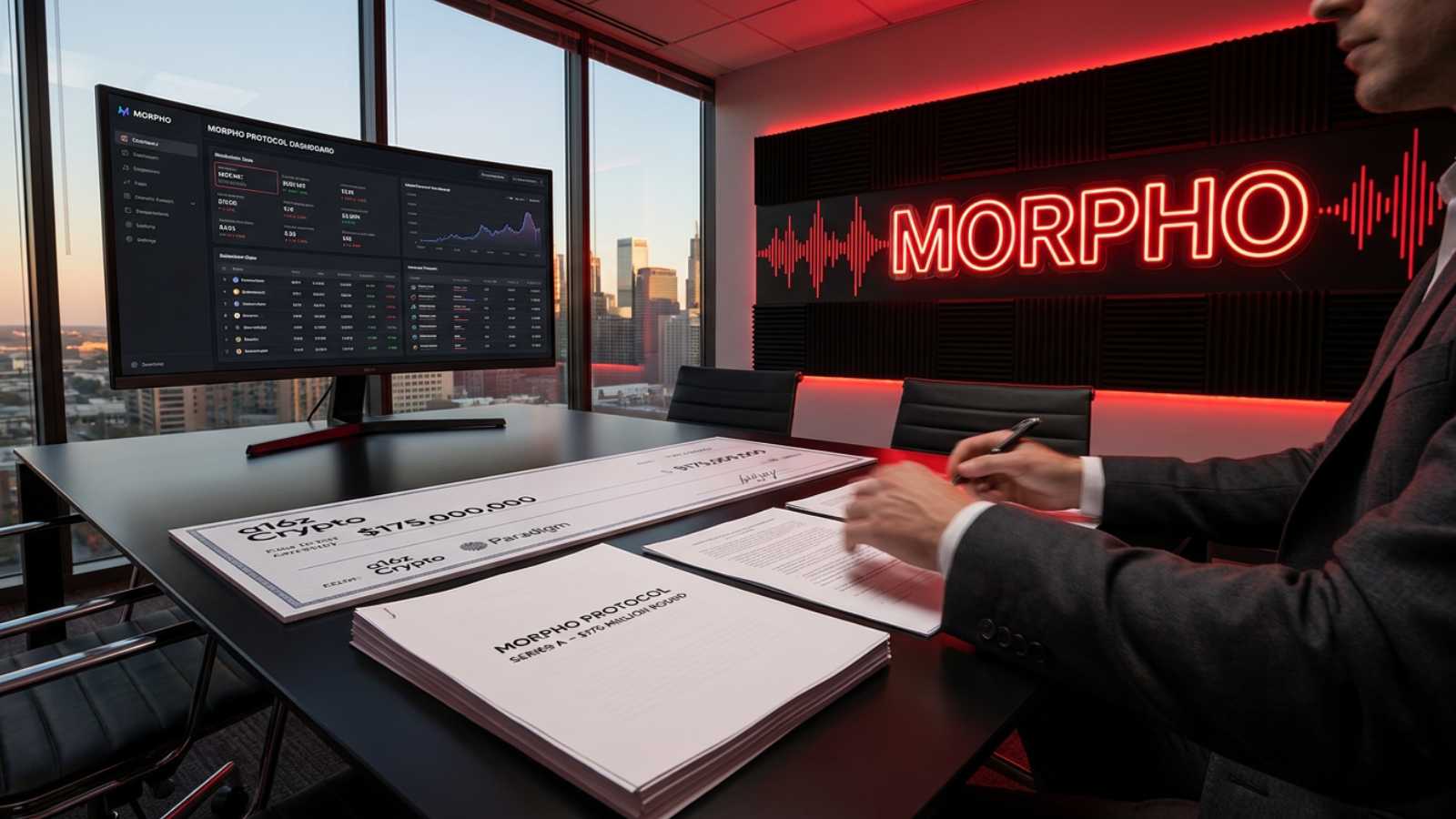

Funding $175 Million Amid Crypto Investor Shift
June 9, 2026. Morpho closed a $175 million funding round with a16z Crypto and Paradigm as co-lead investors. Not an unusual figure in the crypto ecosystem, but the context is exceptional: 2 of the most selective venture firms in the sector chose to make a large bet not on a new exchange, not on a faster layer 1, but on the most fundamental layer of blockchain-based credit systems.
This investment arrives at an inflection point. Post-FTX crypto markets have shifted posture. The dominance of centralized exchanges (CEX) as the sole gateway to liquidity has eroded systematically. The DeFi narrative, once shadowed by exploits and protocol collapses, is being slowly rehabilitated by protocols that survived, grew organically, and proved product-market fit without marketing noise. Morpho falls into that last category.
What makes this round more than capital is the framing: "foundational infrastructure for global on-chain credit markets". Not a dApp. Not a yield optimizer. Infrastructure. This shift in framing determines how investors, developers, and institutions will view Morpho over the next 5 to 10 years.
Morpho's Architecture: Why "Primitive" Is the Key Word
Morpho is not a lending protocol that emerged out of nowhere. It started as a peer-to-peer optimization layer on top of Aave and Compound, allowing users to get better interest rates by matching lenders and borrowers directly before excess liquidity flowed to main pools. Simple concept, effective.
Its biggest evolution came with the launch of Morpho Blue: a primitive lending protocol, immutable, permissionless, and modular. Morpho Blue holds no opinions about which collateral is safe, which oracle is trustworthy, or which risks are acceptable. All those decisions are delegated to the layer above it: MetaMorpho vaults, managed by independent risk curators.
This model runs on strict modularity: the core protocol stays simple and cannot be modified, while product variation, risk strategies, and market targeting are served by a fully customizable vault layer. Risk curators, whether experienced DeFi institutions, DAOs, or traditional banks entering on-chain, choose which collateral to accept, which oracle to use, and which parameters apply.
The architecture resembles the difference between TCP/IP and applications built on top of it. Morpho Blue is the network protocol; lending applications are what gets built above it.
// Simplified Morpho Blue core interface (illustrative)
interface IMorphoBlue {
    struct MarketParams {
        address loanToken;
        address collateralToken;
        address oracle;
        address irm;        // Interest Rate Model
        uint256 lltv;       // Liquidation LTV
    }

    function supply(
        MarketParams calldata marketParams,
        uint256 assets,
        uint256 shares,
        address onBehalf,
        bytes calldata data
    ) external returns (uint256 assetsSupplied, uint256 sharesSupplied);

    function borrow(
        MarketParams calldata marketParams,
        uint256 assets,
        uint256 shares,
        address onBehalf,
        address receiver,
        bytes calldata data
    ) external returns (uint256 assetsBorrowed, uint256 sharesBorrowed);
}
Immutability at the core level is a deliberate design choice: the protocol cannot be upgraded and has no governance token that can retroactively veto risk parameters. This eliminates one of the largest attack vectors in DeFi: governance attack, where a bad actor acquires voting power to destructively change protocol parameters.
The Investment Logic Behind a16z and Paradigm
a16z Crypto and Paradigm are not firms easily swayed by cycle hype. Both have a track record of long-term infrastructure investment: a16z in Coinbase, Uniswap, and Optimism; Paradigm in Blur, Optimism, and several other DeFi primitives. When they co-lead a round together, it signals they are seeing the same market from 2 independent analytical angles.
The investment thesis can be formulated this way: the next crypto cycle will not be driven by retail speculation alone. Institutions, hedge funds, and some sovereign wealth funds have already started allocating to digital assets. All of these entities ultimately need credit, leverage, and treasury management more sophisticated than buy-and-hold. They need credit infrastructure that is auditable, non-custodial, and transparent.
"The shift from CEX to DeFi is not about anti-centralization ideology. It is about counterparty risk. After 2022 and 2023, many institutions chose auditable smart contract risk over opaque human risk."
The "product-market fit" framing mentioned in the funding context matters. In early DeFi, lending protocols grew because of token incentives, not organic usage. Once incentives ended, TVL collapsed. Protocols that survived are those with users because of real need, not subsidy. Morpho falls into that category, and a16z and Paradigm read that signal as justification for long-term valuation.
The Competition Landscape: Who Else Is Targeting This Position
Morpho is not the only player in on-chain credit infrastructure, but its architectural approach sets it apart from main competitors.
| Protocol | Architectural Model | Governance | Core Immutability | Primary Market Target |
|---|---|---|---|---|
| Morpho Blue | Modular primitive + vault layer | Limited, core immutable | Yes | Institutions, risk curators |
| Aave v3 | Single pooled market | DAO via AAVE token | No | Retail + institutions |
| Compound v3 | Isolated comet markets | DAO via COMP token | No | Retail |
| Euler v2 | Modular via EVC | DAO | Partial | DeFi-native developers |
| Spark Protocol | Fork Aave + MakerDAO | MakerDAO governance | No | DAI ecosystem |
Aave is the largest protocol in this category by brand popularity and TVL history. But its active governance model means risk parameters can change via vote, and this becomes a trade-off not all institutions want to accept when considering large capital allocation.
Euler Finance was once a serious competitor with a modular approach before suffering a major exploit in 2023 and relaunching as Euler v2. That comeback actually validated that modularity is the direction top DeFi teams believe is correct, and Morpho had already built reputation on that path.
What makes Morpho's position attractive to VCs is not just current TVL size, but how it is positioned as a "lower layer" that all players above can use. Risk curators from the Aave ecosystem could theoretically build vaults on top of Morpho Blue. This is not zero-sum competition; this is an offer to be the foundation.
Interest Rates and On-Chain Credit Mechanics
One technical detail that determines a lending protocol's competitiveness is the interest rate model. Morpho Blue uses AdaptiveCurveIRM, an adaptive interest rate model that adjusts based on the utilization rate in each market independently.
In the standard utilization-based model, the interest rate for borrowers is calculated based on utilization ratio U:
where U_opt is the target utilization (typically 80 to 90 percent), r_slope1 is the rate increase below target, and r_slope2 is the much steeper increase above target to encourage liquidity return.
Morpho Blue's AdaptiveCurveIRM takes one step further: it automatically adjusts the interest rate curve based on how long utilization deviates from target, making each market more self-regulating without governance intervention.
// Querying Morpho Blue market state via SDK
import { MorphoBlue } from "@morpho-org/blue-sdk";

const morpho = new MorphoBlue({ chainId: 1 });

const marketParams = {
  loanToken: "0xA0b86991c6218b36c1d19D4a2e9Eb0cE3606eB48",   // USDC
  collateralToken: "0xC02aaA39b223FE8D0A0e5C4F27eAD9083C756Cc2", // WETH
  oracle: "0x...",
  irm: "0x870aC11D48B15DB9a138Cf899d20F13F79Ba00BC",          // AdaptiveCurveIRM
  lltv: BigInt("860000000000000000"),                          // 86% LLTV
};

const state = await morpho.getMarketState(marketParams);
console.log({
  totalSupply:  state.totalSupplyAssets,
  totalBorrow:  state.totalBorrowAssets,
  utilization:  state.utilization,
  supplyAPY:    state.supplyApy,
  borrowAPY:    state.borrowApy,
});
This system positions Morpho closer to financial primitives that developers and institutions can compose, not just a retail lending application.
Real-World Assets: The Next Frontier
One of the most significant frontiers for Morpho's infrastructure is its potential as a credit rail for real-world assets (RWA). The modular vault-based architecture is well-suited for this use case: risk curators can create markets with tokenized RWA collateral, like tokenized government bonds, trade receivables, or real estate tokens, while using specialized oracles to handle off-chain asset pricing.
Several financial institutions in the United States, United Kingdom, and Gulf Cooperation Council (GCC) region are already exploring the tokenization of traditional assets on blockchain. Auditable, permissionless, and battle-tested credit infrastructure like Morpho Blue becomes a strong candidate as the execution layer when these assets need on-chain liquidity.
This is what distinguishes this $175 million round from ordinary DeFi protocol funding. Morpho is being positioned as the meeting point between existing on-chain capital and off-chain assets being tokenized globally. Not just native crypto markets, but the far larger financial market.
Systemic Risks That Cannot Be Ignored
The "global infrastructure" framing carries responsibilities that are not small. The larger the total value locked depending on Morpho Blue, the larger the target that must be defended.
Smart Contract Risk
Morpho Blue is immutable, but immutability is a double-edged sword. Bugs discovered after deployment cannot be fixed without a full migration. The protocol has undergone multiple audits from leading firms, but DeFi history shows that audits are not a guarantee of zero exploits. Emergency migration amid market stress is a scenario no protocol wants to experience.
Oracle Manipulation
The risk-isolated model means each market has its own oracle. This is good for limiting blast radius between markets, but it also means a market with a weak oracle can become an entry point for manipulators. Governance attack is eliminated, but oracle attack remains a real vector.
Regulatory Landscape
DeFi regulation in the United States and European Union is still taking shape. Markets in Crypto-Assets (MiCA) in the EU and SEC framework developments in the US could impact how institutions interact with non-custodial protocols. Risk curators based in specific jurisdictions may need to navigate different rules, and some may not be able to operate fully without legal clarity.
Risk Curator Concentration
If most TVL is concentrated in a few vaults managed by the same risk curator, the diversification promised by the modular architecture becomes an illusion. Dependence on a small number of large risk curators creates an operational single point of failure that is different from, but no less dangerous than, governance centralization.
The $175 million funding from a16z and Paradigm provides capital legitimacy, but does not eliminate technical risk. Before allocating to a Morpho-based vault, institutional investors must validate the audit trail of the chosen risk curator, the track record of the oracle used in that market, and how the liquidation mechanism functions under stressed market or flash crash conditions.
Convergence: When Lending Protocol Becomes Global Financial Plumbing
What is happening with Morpho is not an isolated phenomenon. It is part of a larger convergence between blockchain infrastructure and traditional financial needs. Stablecoins have entered payment rails. Tokenized treasury bonds are accessible on-chain. The logical next step is credit: borrow, use leverage, manage risk, all without the traditional counterparty that becomes the single point of failure.
The global credit market is worth hundreds of trillions of dollars. Even a small fraction migrating on-chain will form a new asset category requiring infrastructure like Morpho. It is no accident that a16z and Paradigm entered precisely at this moment, when the RWA narrative has moved past proof-of-concept and is entering real deployment phase.
The relevant question is no longer "can DeFi lending survive?" Morpho has already moved past that phase. The sharper question is who will be the TCP/IP of the global on-chain credit market. With $175 million behind it and architecture designed to be foundation, not application, Morpho is taking position as the most serious answer to that question.
Share Article
Share
Disclaimer
All content presented in this article is for informational purposes only and should not be considered as financial advice. The author and publisher are not licensed financial advisors. Any investment decisions made by readers are personal choices, and all risks are solely borne by the reader. We strongly recommend conducting independent research and consulting with a licensed financial advisor before making any financial decisions.