Nvidia Vera CPU: Data Center Processor for Global AI Agent Infrastructure
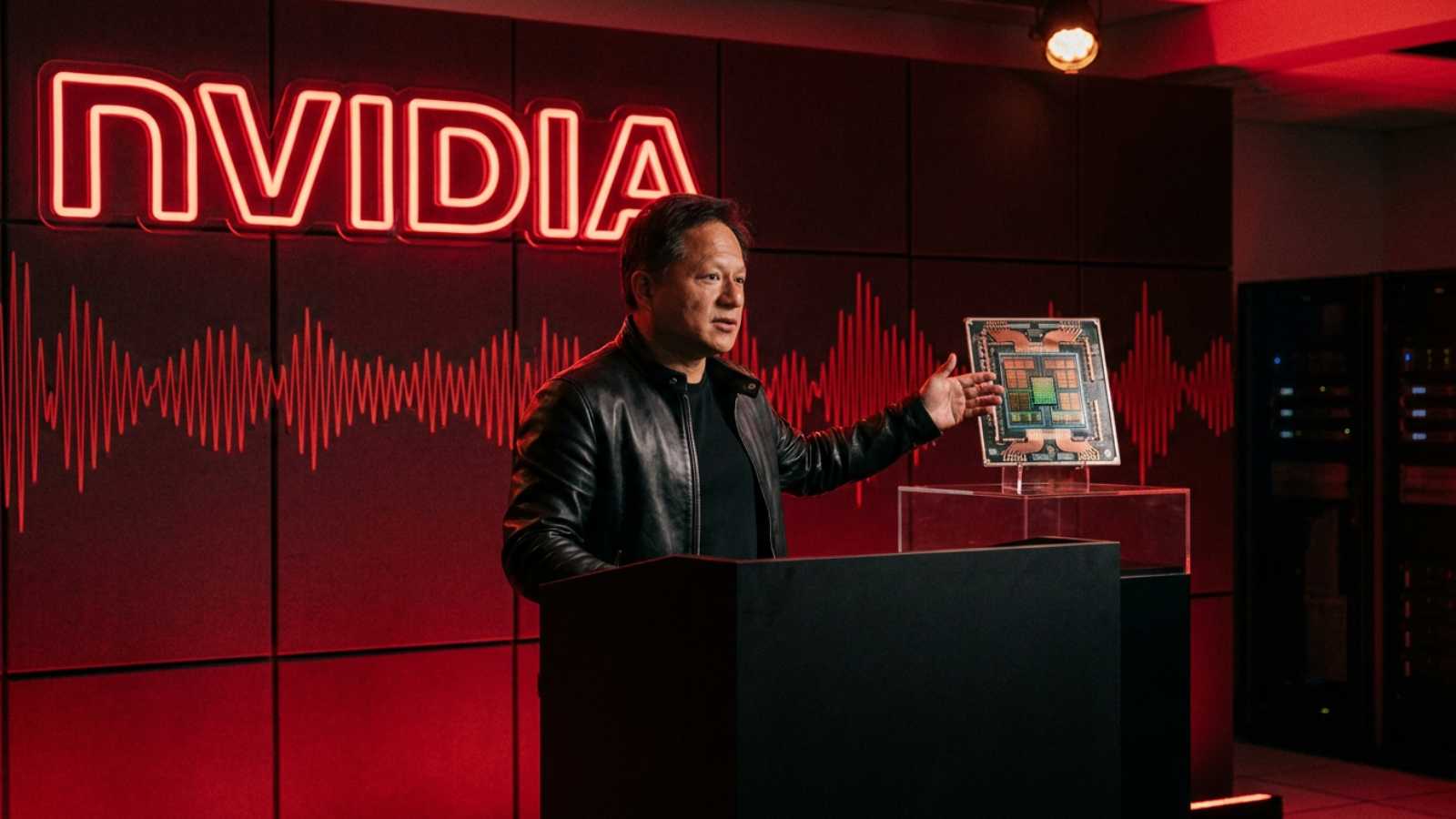

CPU Engineered for Global-Scale AI Agent Workloads
Jensen Huang doesn't do half measures. When Nvidia announced Vera CPU for data center environments with full production schedule in fall 2026, three names immediately appeared on the early adopter list: Anthropic, OpenAI, and SpaceXAI. These are not just big names for a press release. All three are building the most ambitious AI agent infrastructure in the world, and they chose Vera as its foundation.
The significance of this choice becomes clear only when you understand what AI agents actually need at production scale. The answer is not just GPUs.
Why CPUs Suddenly Matter Again in the AI Era
For the past few years, conversations about AI compute have almost always revolved around GPUs. Makes sense: training large language models requires thousands of GPUs working in parallel. But the category exploding now is not training, but inference, and more specifically: multi-step agentic inference.
AI agents differ from static chatbots. Agents operate in complex loops: planning, tool-calling, memory retrieval, context management, and decision branching. All these stages require coordination among concurrently running processes. The CPU is the component that handles that coordination. GPUs can run inference with high throughput, but without a CPU capable of managing the orchestration layer with low latency, the entire agent system becomes structurally inefficient.
Nvidia understood this earlier than most. Vera CPU was designed from the start for this context, not just a generic server CPU paired with Nvidia GPUs by coincidence.
From Grace to Vera: The Evolution of Nvidia CPU Architecture
To understand Vera, you need to trace Nvidia's path as a CPU company. Before Vera, there was Grace, a custom ARM-based CPU paired with Hopper and later Blackwell in the NVLink platform. Grace Hopper Superchip became the foundation of DGX H100 systems and cloud deployments on AWS, Google Cloud, and Microsoft Azure.
Vera is the next iteration. This new-generation CPU is paired in the Vera Rubin platform, where Rubin is the next-generation GPU after Blackwell. Vera does not stand alone. It is part of Nvidia's vertical integration strategy that spans every layer:
- CPU (Vera) for orchestration and host compute
- GPU (Rubin) for parallel inference
- Interconnect (NVLink, NVSwitch) for inter-chip bandwidth
- Networking (Spectrum-X, InfiniBand) for cluster communication
- Software stack (CUDA, NIM, NEMO, Triton) as the top layer
Huang calls this an effort to own every layer of the AI stack. This strategy is not new for Nvidia, but Vera is the point where that ownership becomes increasingly vertical from the host processor side.
In this architecture, Vera's position is not at the end of the pipeline but at the center of coordination. The GPU runs the heavy inference workload, but Vera decides what the GPU should run, when, and in what order.
Anthropic, OpenAI, SpaceXAI: Three Early Adopters with Different Needs
These three early adopters have similar needs on the surface but different technical requirements underneath.
Anthropic is building Claude as a system designed for long agentic tasks. Extended thinking, multi-hop reasoning, and complex tool use all depend on orchestration layer efficiency. Every token in an agentic chain requires a decision on whether to continue reasoning, call an external tool, or end the chain. A slow CPU at this point becomes a bottleneck directly visible in end-user latency.
OpenAI with its GPT and o-series ecosystem faces a different problem: absolute scale. When millions of users run agents simultaneously, CPU bottleneck is not just about per-request latency but overall server throughput. Vera is positioned to handle this with high-bandwidth memory and a cache hierarchy optimized for LLM workloads.
SpaceXAI is the most different case. Their deployment context is not just in conventional cloud data centers. AI in the SpaceX context includes autonomous systems for flight planning, telemetry processing, and communication network management for Starlink. Vera, with its power-efficient design and characteristic features of ARM architecture, is relevant for contexts where power budget is a real constraint.
Competition in the Field: Vera vs Intel, AMD, and Arm
Nvidia's entry into the data center CPU market is not without resistance. Intel and AMD have long dominated this segment, while Arm Holdings through Neoverse has significant traction in cloud-native workloads.
| Processor | Architecture | Primary Focus | Advantages | Disadvantages vs Vera |
|---|---|---|---|---|
| Intel Xeon (Granite Rapids) | x86-64 | General purpose, enterprise | Mature software ecosystem, broad compatibility | Lower power efficiency, no native NVLink |
| AMD EPYC (Genoa/Turin) | x86-64 | High core count, cloud | High core density, competitive efficiency | No native NVLink integration |
| Arm Neoverse V3 | ARM | Cloud native, efficiency | Good power efficiency, scalable | No integrated AI software stack |
| AWS Graviton 4 | ARM (custom) | AWS-native workloads | Cost efficiency on AWS | AWS vendor lock-in, not portable |
| Nvidia Vera | ARM (custom Nvidia) | AI agent orchestration | Native NVLink, CUDA ecosystem, full-stack | Non-Nvidia ecosystem requires adaptation |
What differentiates Vera from competitors is not just raw performance. Intel Xeon and AMD EPYC are both highly capable processors for conventional enterprise workloads. Vera's advantage lies in vertical integration: when CPU and GPU come from the same vendor, with interconnect designed together (NVLink) and a curated software stack (CUDA, NIM, Triton), inter-component latency is reduced structurally because the entire system speaks the same language.
"Nvidia is not trying to be Intel. They're building something more specific: a compute system where every layer, from silicon to software framework, is optimized for a single purpose: AI agents at production scale."
This is an advantage that Intel and AMD will find hard to match in the short term because it requires more than just making a competitive chip. It requires an ecosystem built over more than a decade.
AI Agent Infrastructure: Why Orchestration Is More Complex Than It Appears
Understanding why Vera is relevant requires understanding how AI agent architecture differs from previous AI applications.
Simple inference works like a linear pipeline: input goes in, model processes, output comes out. The CPU only needs to be an efficient dispatcher. But modern AI agents, especially those using frameworks like LangGraph, AutoGen, or Claude's Tool Use API, operate in complex graphs with multiple state transitions:
- Planning phase: The LLM analyzes the task and creates a multi-step plan based on context
- Tool selection: The agent selects relevant tools from a catalog that can reach hundreds of items
- Parallel execution: Multiple tools can run simultaneously for time efficiency
- Result synthesis: Results from multiple tool calls are combined into new context
- Decision branch: The agent decides whether another iteration is needed or the task can end
- Memory write: State is saved to a vector store or key-value store for next session context
Each stage requires the CPU to manage state machines, routing, and memory coordination. At hyperscale with millions of agent instances running concurrently, CPU bottleneck can defeat even the best GPU advantages.
Fall 2026: Strategic Timing
Vera's full production schedule in fall 2026 arrives at the right moment because several trends are converging.
First, the explosion of AI agent deployment. Platforms like Copilot (Microsoft), Gemini (Google), and Claude (Anthropic) are all aggressively expanding their agentic capabilities. Compute demand for multi-step agents will increase dramatically throughout 2026-2027 as enterprises start deploying agents at production scale.
Second, hyperscaler market consolidation. AWS, Google Cloud, Microsoft Azure, and Oracle Cloud Infrastructure are all racing to offer dedicated compute for AI agent workloads. Vendors who can offer a full-stack solution, not just GPUs but also optimized CPUs, will have an advantage in large enterprise deals.
Third, the shift from prototype to production. Many companies that spent 2024-2025 experimenting with AI agents are now preparing for production-scale deployment. They need hardware designed for reliability and efficiency in 24/7 workloads, not lab benchmarks.
SpaceXAI as an early adopter is particularly interesting because it shows that the Vera market is not limited to conventional cloud AI providers. There are use cases in aerospace, autonomous systems, and edge deployment that may be larger than analysts initially estimated.
Real Risks in Nvidia's Full-Stack Strategy
Not all analysts agree that Nvidia's vertical strategy is the best path. There are several concrete risks that need to be read clearly.
Vendor lock-in. When Anthropic or OpenAI build infrastructure on top of Vera+Rubin+NVLink+CUDA, their switching costs increase significantly. This benefits Nvidia in the short term but creates structural dependency that could become a contract negotiation problem in the future, especially as AI hardware competition intensifies.
Antitrust exposure. Nvidia is already on regulators' radar in various jurisdictions regarding GPU dominance for AI. Expansion into data center CPUs broadens the footprint that needs to be justified from a market competition perspective, especially in the European Union, which is most aggressive in tech antitrust oversight.
x86 software ecosystem. Intel Xeon and AMD EPYC have decades of software ecosystem. ARM in the data center is growing rapidly, but there is still friction for certain workloads, especially legacy enterprise software that lacks optimized ARM-native builds.
Chip geopolitics. The semiconductor supply chain remains vulnerable to geopolitical tensions. Nvidia, like the rest of the industry, depends on TSMC for advanced node fabrication. This is not unique to Nvidia, but it remains a factor CTOs need to consider when planning a 3-5 year infrastructure roadmap.
A Competition Landscape in Flux
The AI hardware competition landscape in mid-2026 is no longer simple like the narrative "Nvidia dominates, everyone loses." Now there are more diverse players:
- Google TPU v6 (Trillium): Dominant for Google internal use, not sold to third parties
- AWS Trainium 2 + Inferentia 3: Strong within the AWS ecosystem, less portable outside
- Microsoft Azure Maia 100: Optimized for Azure-specific workloads
- Groq LPU: Latency-focused for fast single-model inference
- Cerebras WSE-3: Extreme scale for specific model training
Among all this, what is unique about Nvidia is that they are the only vendor that commercially has the largest GPU ecosystem (CUDA is unmatched in library coverage), its own natively integrated CPU (Vera), its own networking fabric (InfiniBand, Spectrum-X), and an end-to-end software stack from silicon to framework.
No other vendor commercially owns all four of these layers. AMD has CPU and GPU but lacks equivalent networking fabric and software stack. Intel has CPU and some accelerators but lacks an AI GPU approaching Nvidia in adoption. Google and AWS have comprehensive solutions but only for their own internal cloud consumption.
Vera is not just a CPU product. It is a statement that Nvidia has no plans to leave any gaps in its stack that competitors could fill, and the selection of Anthropic, OpenAI, and SpaceXAI as early adopters is the strongest argument they can make to the market before this chip even enters full production.
Share Article
Share
Disclaimer
All content presented in this article is for informational purposes only and should not be considered as financial advice. The author and publisher are not licensed financial advisors. Any investment decisions made by readers are personal choices, and all risks are solely borne by the reader. We strongly recommend conducting independent research and consulting with a licensed financial advisor before making any financial decisions.