S&P 500 Rejects Waivers for SpaceX, OpenAI, and Anthropic: GAAP Profitability Remains Index Entry Standard
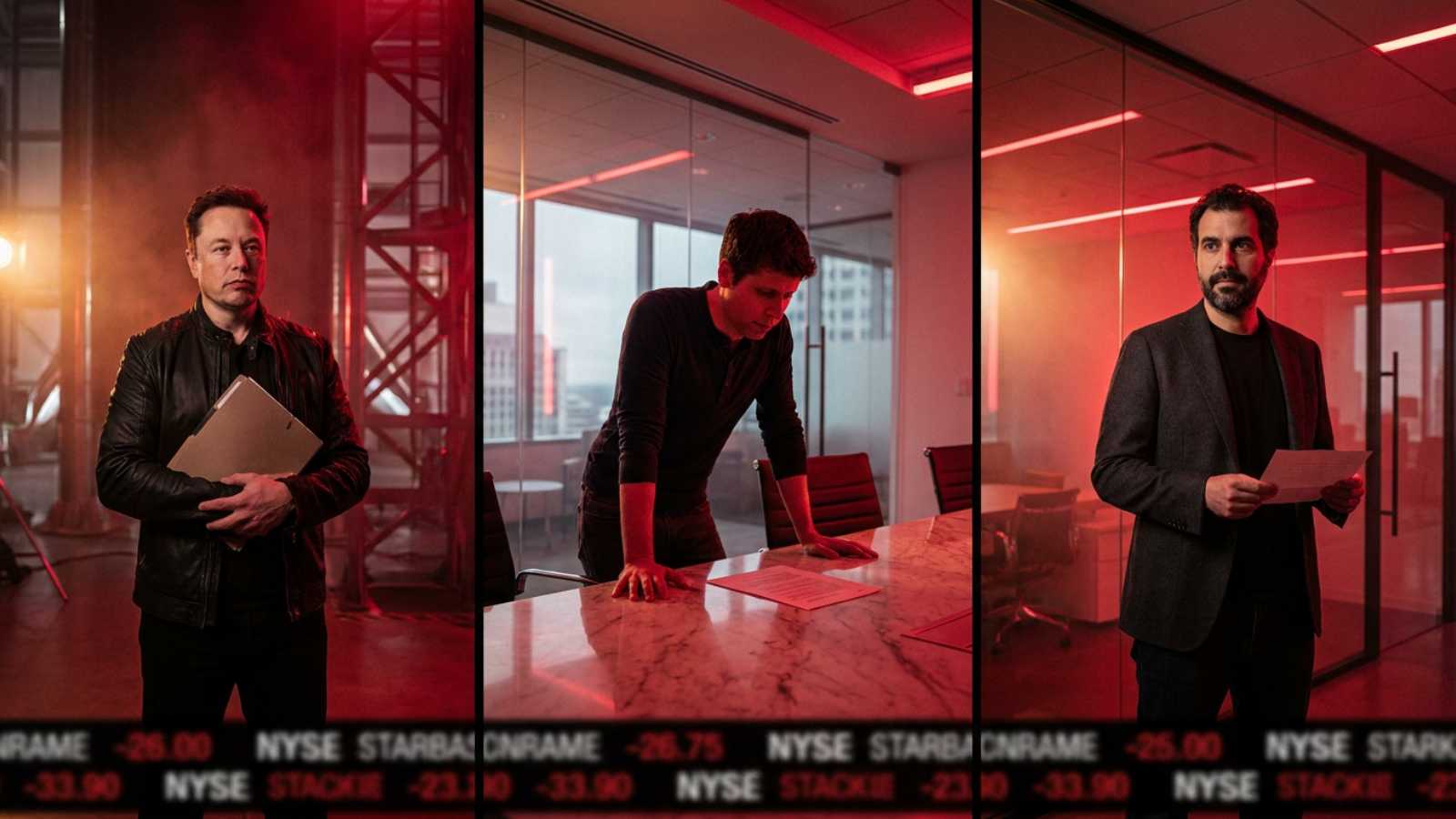

Three Biggest Names in Tech Rejected at S&P 500's Door
Thursday, June 4, 2026. S&P Global issued an official decision: no fast track into S&P 500 for SpaceX, OpenAI, or Anthropic. All waiver requests were rejected. All three must go through the standard process: 12 months of seasoning period after listing on a public exchange, plus proving positive profitability under GAAP (Generally Accepted Accounting Principles) for 4 consecutive quarters before being eligible for consideration as an index component candidate.
Within 24 hours, the news trended on Hacker News. Not because the decision was procedurally surprising, but because it explicitly collided two realities that had long been masked: trillion-dollar private valuations built on projections of future growth, versus public accounting standards that ignore narrative.
This is the moment Wall Street, as an institution, stated that "promising" and "profitable" are two different things. And that difference is expensive.
S&P 500 Rules That Know No Compromise
S&P 500 is not just a list of 500 large companies. It is a benchmark followed by more than $7 trillion in assets under management globally, from retail passive funds to large institutional pension funds. When a company enters this index, the market mechanism at work is automatic: every ETF and passive fund tracking the S&P 500 must buy shares of that company proportionally, without considering fundamental opinion.
That is why S&P Global established non-negotiable filters:
- GAAP profitability positive for the last 4 fiscal quarters cumulatively. Not adjusted EBITDA. Not non-GAAP earnings that can be manipulated by excluding "non-recurring costs" that somehow appear every quarter. GAAP means counting everything: stock-based compensation, depreciation, amortization, and all real expenses often obscured in high-growth company financial reports.
- 12-month seasoning period after the company officially lists on a US public exchange. This allows time for the stock price to move beyond IPO euphoria before being added to the global index.
- A minimum market capitalization sufficient for a new component.
- A minimum of 50% of outstanding shares available to the public (float requirement).
The first criterion is the main barrier. SpaceX, OpenAI, and Anthropic are not small irrelevant companies. The opposite: they loom large in industry narrative, but lack sufficient profitability in GAAP financial reports. The requested waiver? Rejected outright.
SpaceX: Revenue Up 33%, But $4.94 Billion Loss
Of the three, SpaceX is the most transparent financially. The numbers illustrate the contradiction starkly.
In 2025, SpaceX recorded a net loss of $4.94 billion despite 33% year-over-year revenue growth. This is not mere statistics. It reflects two programs simultaneously in phases of massive capital investment:
- Starship: Every test flight is not free technology demonstration. It is real operational spending that goes straight into the financial records. Manufacturing facilities in Boca Chica and launch infrastructure at multiple sites require consistent and large costs.
- Next-generation Starlink constellation: Deployment of thousands of satellites runs in parallel. Production costs, launch costs (though using its own rockets), and ground station costs all factor into P&L.
The paradox is structural: the more aggressively SpaceX executes its technical roadmap, the deeper the short-term losses it books. This trade-off is intentional by management. But S&P 500 is not interested in trade-off arguments.
Numbers That Make This Decision More Than Procedure
The reason for early waiver pressure lies in estimates of passive fund flows calculated by S&P analysts. If these three companies were allowed fast-track entry into S&P 500, automatic buying from passive funds tracking the index would trigger inflow on a massive scale in short order.
S&P estimates:
- SpaceX would receive $14 billion in automatic passive buying.
- OpenAI would receive $8 billion.
- Anthropic would receive $4.6 billion.
Over $26 billion in instant liquidity flowing into the three companies simply because they are on the index list. This is the biggest reason why S&P 500 inclusion is so coveted, not just symbolic prestige.
But this is also why S&P Global is cautious. If profitability standards were loosened, then pension funds of millions of American workers, university endowments, and sovereign wealth funds around the world would be forced to buy shares of companies still losing money under GAAP. Passive funds have no mechanism to refuse that purchase. They must buy, whatever the fundamental condition.
GAAP profitability standards are not arbitrary barriers. This is structural protection for passive investors with no choice but to buy when index composition changes. Loosening those requirements means shifting risk from companies to retirees.
Historical Comparison: From Amazon to Tesla
The June 2026 decision is not without precedent. Similar cases have occurred, and the pattern is informative.
| Company | IPO Year | S&P 500 Entry Year | Gap (Years) | Profitability Condition at Entry |
|---|---|---|---|---|
| Amazon | 1997 | 2005 | 8 years | Profitable since 2001, consistent thereafter |
| Google (Alphabet) | 2004 | 2006 | 2 years | Profitable before IPO |
| Meta (Facebook) | 2012 | 2013 | 1 year | Profitable despite post-IPO volatility |
| Tesla | 2010 | 2020 | 10 years | 4 consecutive quarters of GAAP profitability |
| SpaceX | Not yet IPO'd | Not yet entered | - | $4.94 billion loss (2025) |
| OpenAI | Not yet IPO'd | Not yet entered | - | Not disclosed |
| Anthropic | Not yet IPO'd | Not yet entered | - | Not disclosed |
Tesla is the most relevant precedent. IPO'd in 2010, but only entered S&P 500 in December 2020, after finally proving 4 consecutive quarters of GAAP profitability in a row. That was 10 years. When Tesla entered, it became one of the largest single additions in S&P 500 history, triggering massive rebalancing that temporarily rocked Tesla's stock price due to technical market pressure.
SpaceX, OpenAI, and Anthropic are at the beginning of the same path Tesla walked in 2010-2015: strong in narrative, but not yet cleared for index entry standards.
Implications for IPO Timeline and AI Capital Structure
The S&P Global decision is not merely regulatory news. It forces these three companies and the investor ecosystem around them to revise several assumptions at once.
IPO timeline becomes more layered. There was an implicit assumption in the VC community before: "Once IPO closes, S&P 500 entry is just a matter of short time." That assumption now collapses formally. IPO only opens the first door. Entering S&P 500 requires 12 months minimum post-IPO, plus GAAP profitability proof. For Anthropic, where compute spending for frontier model training will not stop anytime soon, this could mean a gap of several years between IPO and S&P 500 inclusion.
Pressure toward short-term profitability could shift strategic direction. This is the crux. If SpaceX or OpenAI management feel too pressed to chase GAAP profitability to accelerate index entry, they may need to slow R&D investment velocity. That could slow Starship development, reduce the scale of next-generation AI model training, or cut fundamental research programs. This trade-off is real and not trivial.
AI industry financing structure needs re-evaluation. The business model of all three companies currently depends heavily on venture capital and strategic investment from large corporate partners: Microsoft to OpenAI, Amazon and Google to Anthropic, and institutional investors to SpaceX. Until they are in S&P 500, they lack access to the cheapest public financing mechanism: passive funds that buy not from fundamental conviction but because index rules require it.
This creates a structural imbalance. A software company already profitable but far below OpenAI in innovation could enter S&P 500 sooner simply because its R&D spending is smaller and its bottom line cleaner.
Structural Contradiction: Private Valuation vs GAAP Reality
The tension visible here is neither new nor unique to AI. This is the classic contradiction in the modern tech ecosystem: valuations built on Total Addressable Market and future projections, versus profitability metrics calculated from current business activity.
OpenAI and Anthropic both carry "hyper-unicorn" valuations based on their most recent private funding rounds. But private valuations do not match value recognized by public accounting systems and capital market indices.
What is quantitatively different this time compared to the Amazon era or even Tesla is the scale. Spending to train frontier AI models vastly exceeds anything ever seen in tech. Training one frontier model generation can cost hundreds of millions to billions in compute alone, before researcher costs, data infrastructure, and energy. That spending will not stop just because a company wants to look profitable on paper.
And as long as that spending continues at current scale, GAAP profitability remains extremely difficult without fundamental business model change or dramatic cuts to technical ambition.
Real Risks That Cannot Be Ignored
From the perspective of developers, engineers, and investors in the global AI ecosystem, there are concrete risks in the landscape post-June 2026 decision worth watching.
Pressure on equity compensation. RSUs (Restricted Stock Units) held by OpenAI, Anthropic, or SpaceX employees currently derive value from private valuations with severely limited liquidity. Without a clear IPO timeline and without a predictable S&P 500 entry path, equity-holding employees bear long-term uncertainty absent in already-listed tech companies.
Competition for talent risk. In a market where Google DeepMind, Meta AI, and Microsoft Research already have publicly traded shares and more liquid compensation, privately-held or newly-IPO companies without S&P 500 inclusion must offer higher talent premiums to attract top-tier people. That is added cost further squeezing profitability.
Late-stage investor exit risk. Investors in final rounds before IPO, from sovereign wealth funds to late-stage VCs, have entered at valuations assuming liquidity events within certain timeframes. A longer timeline to S&P 500 inclusion extends the holding period before they capture the full valuation premium from passive buying inflow. Their internal rate of return compresses.
Dual-class share structure risk. Many large tech founders use dual-class share structures to retain voting control post-IPO. S&P Global has revised policies on this previously. Depending on how SpaceX or OpenAI structure their IPO, this factor could become another variable in eligibility review.
Long Term: A Filter That May Prove Beneficial
There is a more optimistic argument, often overlooked in initial discussion after the announcement.
Pressure to meet S&P 500 standards can function as healthy disciplinary mechanism. A company seeking index entry must prove its business model is sustainable by standard accounting, not just in investor decks. If SpaceX achieves GAAP profitability while still executing the Starship program, that is far stronger evidence they are building fundamentally sound business not merely burning through venture capital indefinitely.
The same for OpenAI and Anthropic. If they eventually enter S&P 500, it is not just symbolic legitimacy or access to passive funds. It means they have passed a hard test most other "AI startups" will never clear: proving frontier technology can actually make money, not just promise it on paper.
Speed is not the only metric. Amazon took 8 years post-IPO to enter S&P 500. Tesla took 10 years. Both are now among the index's heaviest weighted components.
And the $14 billion passive buying for SpaceX, $8 billion for OpenAI, $4.6 billion for Anthropic? All of it still waits at the end of the same road, as long as they meet the requirements. S&P Global is not barring entry. They are just rejecting the shortcut.
That distinction is crucial, because it reframes the actual question not as "when can they enter?" but "how fast can they become profitable without sacrificing the competitive edge that makes them worth entering in the first place?"
Share Article
Share
Disclaimer
All content presented in this article is for informational purposes only and should not be considered as financial advice. The author and publisher are not licensed financial advisors. Any investment decisions made by readers are personal choices, and all risks are solely borne by the reader. We strongly recommend conducting independent research and consulting with a licensed financial advisor before making any financial decisions.