Ukrainian AI Drones and the Transformation of Global Defense Strategy

Battlefield as Living Laboratory for Autonomous Technology
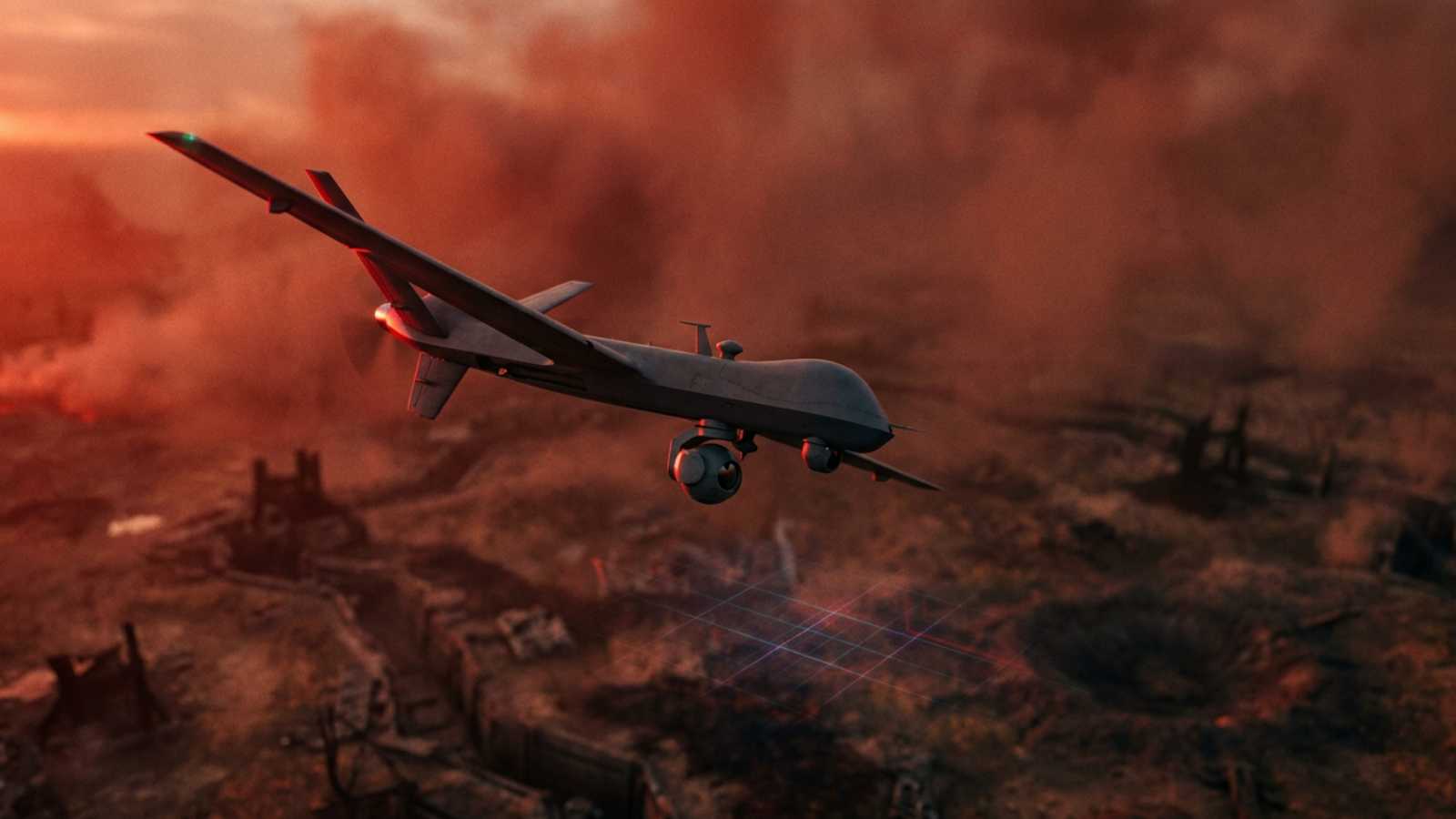
A Ukrainian drone operator sits in a tactical bunker, watching video feed from 50 meters above the front line. The drone being controlled differs from models deployed a year prior: when Russian electronic jamming systems cut GPS signals, this device doesn't stop. Onboard cameras read terrain contours, recognize target thermal profiles through computer vision, and continue the mission without satellite coordinates. The operator needs only final confirmation.
This is not a laboratory demonstration. This is active field operation documented by Bloomberg and various international defense outlets as of mid-2026.
Four years into Russia's full-scale invasion of Ukraine, the battlefield there has become the largest live test in history for AI-based weapons systems. No simulator could replicate the operational complexity: high-intensity electronic warfare, damaged communication infrastructure, and an adversary adapting anti-drone tactics weekly. That experience is generating technical blueprints and doctrine now studied by the Pentagon, NATO headquarters, defense ministries in Seoul, Tokyo, and Tel Aviv, and defense analysts in London and New York equity desks.
What's underway exceeds one nation's conflict. This is the moment when AI technology meets the most existential military need, and the result is redefining global defense calculations.
From Cheap FPV to Proven Autonomous Systems
Before 2022, military drones meant expensive platforms. The US MQ-9 Reaper ran roughly $30 million per unit, operated by trained pilots thousands of kilometers away. Ukraine inverted that logic fundamentally.
Commercial FPV (First Person View) drones modified into loitering munitions could be produced at cost per unit in the hundreds of dollars. When a single armored military vehicle costs millions, cost-per-kill asymmetry becomes a strategic argument no military doctrine can ignore.
But that's only the first layer of this transformation. Far more significant is AI integration into the drone's operational loop itself.
Previously, an operator had to maintain real-time video connection to steer the drone to target. Russia then deployed aggressive electronic jamming systems that cut control signals. Ukraine's engineering response: drones capable of completing missions even after connection loss. Computer vision for target detection and tracking based on visual and thermal profiles. Inertial navigation independent of GPS. In some publicly reported cases: semi-autonomous multi-drone coordination that divided tasks between airborne scout units and ground strike units.
AeroVironment's Switchblade 600 (AVAV on Nasdaq) carries anti-armor warheads with flight times up to 40 minutes and video-guided terminal guidance. Turkey's Baykar-made Bayraktar TB2, which dominated the war's early phase, now operates alongside low-cost FPV drones built from commercial electronics. Iran-made Shahed-136, used by Russia, proves that cheap platforms with autonomous navigation can saturate conventional air defenses.
What's worth noting: most of these innovations didn't emerge from formal defense acquisition programs that take a decade. They came from small teams of civilian engineers working in weekly iteration cycles, not yearly ones.
Real Application: Who Plays, Where, With What
Ukraine is the most visible data point, not the sole player. AI drone systems have become their own asset class in the global defense landscape.
| System / Platform | Origin | Operational Type | Unit Price Range | Key Advantage |
|---|---|---|---|---|
| FPV Kamikaze (custom) | Ukraine / DIY | Loitering munition | $300–$600 | Extreme cost asymmetry |
| Switchblade 600 | US (AeroVironment) | Loitering munition | ~$6,000 | Anti-armor, video terminal guidance |
| Bayraktar TB2 | Turkey (Baykar) | MALE UAV | ~$5 million | ISR + strike, proven combat record |
| Shahed-136 / 131 | Iran | One-way attack UAV | ~$20,000–$50,000 | Massive production volume |
| Wing Loong II | China (CASC) | MALE UAV | ~$1–2 million | Competitive pricing, technology transfer |
| Harop | Israel (IAI) | Loitering munition | Not published | Radar emission targeting, autonomous homing |
The Pentagon launched the Replicator program to acquire thousands of autonomous drones on a far shorter timeline than conventional procurement routes. This is not marginal: this signals a doctrinal shift from single expensive platforms to distributed autonomous weapon masses.
Israel, through Elbit Systems and Israel Aerospace Industries (IAI), brings an advantage often understated in public discourse: decades of operational combat experience translated into product iteration. Harop, a radar-hunting loitering munition, was already deployed in regional conflicts before Ukraine became global focus.
Turkey has become the player that shifted export defense market dynamics. Baykar has taken orders from more than 20 nations, including African countries that previously lacked access to modern military drone platforms. This isn't just technical achievement; it's geopolitics in the form of export contracts.
Development Direction: Swarm Intelligence, Edge AI, and Multi-Domain Integration
Individual drones are no longer the technology frontier. What the US, China, Israel, and some European players are developing intensively is swarm coordination: hundreds to thousands of small units operating with distributed collective intelligence, independent of centralized command that an adversary could target.
This logic rewrites defense calculations fundamentally. Destroying one command node no longer paralyzes swarm operations. The cost to shoot down each unit in a large swarm formation exceeds the value of the asset being protected. This is new asymmetry driving doctrinal reformulation at the Pentagon, European defense ministries, and PLA headquarters.
Edge AI, the ability to process data and make decisions within a device without connection to a central server, is the technical enabler. Chips for embedded platforms that can run inference models in battlefield conditions are getting new attention from defense divisions at companies like NVIDIA and Qualcomm, and from startups building solutions for GPS-denied and signal-limited environments.
- Computer vision target tracking
- GPS-denied inertial navigation
- Single-unit loitering munition
- Semi-autonomous terminal guidance
- Small swarm coordination (5–50 units)
- Distributed target assignment
- On-device inference without uplink
- Cross-domain sensor fusion
- Thousands of units, autonomous collective
- Self-reconfiguring mission logic
- JADC2 native integration
- Adversarial AI countermeasures
JADC2 (Joint All-Domain Command and Control) is the integration concept the Pentagon is pursuing: air drones coordinating real-time with undersea systems (UUV), autonomous ground vehicles (UGV), and orbital-based assets in a unified architecture. How quickly this matures into proven operational capability in the field will influence global defense budget allocation for the next decade.
US defense startups like Anduril Industries and Shield AI are no longer peripheral players. Anduril builds Lattice, an operating system for autonomous operations that integrates various sensors and platforms in a single command layer. Shield AI develops V-BAT and AI pilot capable of flying platforms without GPS and without communications infrastructure. They fill gaps that traditional prime contractors cannot close in timelines relevant to active conflict.
Risks, Regulatory Barriers, and Dilemmas With No Easy Answer
Investment discussions about defense tech often stop at strong demand thesis. But there's a set of structural risks that must enter the calculation.
International Humanitarian Law (IHL) and Autonomous Weapons. The Geneva Conventions were designed for a world where humans make decisions to take life. When algorithms make that decision, the international legal framework is in unresolved tension. The UN and a global coalition of NGOs have pushed negotiations for a treaty to regulate or ban Lethal Autonomous Weapon Systems (LAWS). The result as of 2026: no binding consensus, no international treaty, only voluntary commitments with no enforcement mechanism.
Modern conflict is no longer won by the side with the largest budget alone. It's won by the side that can close the loop between battlefield failure and the next engineering iteration fastest. This is startup logic, not conventional military acquisition logic.
Proliferation to Non-State Actors. Technology enabling cheap drones to operate autonomously doesn't become harder to access over time. Non-state groups in various conflict zones have already demonstrated capability to build and operate commercial drones modified for combat. AI integration into that capability is the next iteration step, not a leap requiring full state infrastructure.
Training Data Bias. AI models trained to recognize military targets from a specific dataset will degrade in operational environments different from the training data distribution. Target misidentification in military context isn't a code bug patched through routine updates. This is an incident with irreversible consequences, creating legal and reputational liability for system developers and user nations.
Dependence on Adversary-Sourced Components. This contradiction remains systematically unresolved. Drone components on both sides of Ukraine's conflict contain chips and sensors produced by companies operating in the same ecosystem. Efforts to reshore semiconductor supply chains for defense applications require massive investment and years of work, not achievable within active conflict timelines.
Implications for Equity Investors. Defense prime contractors like Lockheed Martin, Raytheon (RTX), and Northrop Grumman were built for large platforms with long acquisition cycles. Ukraine shows that masses of cheap drones can degrade or destroy expensive assets. This isn't direct obsolescence, but margin compression from two directions: pressure to innovate faster than large corporate pace, and competition from leaner startups with different cost structures.
Counter-drone systems become their own growing market. As drone AI becomes more sophisticated in evasion, systems to degrade its capability get new demand. This is a double-sided market: like cybersecurity, offense and defense grow together, often from the same talent and technology sources.
Companies able to build advantages in edge AI for power-constrained platforms, computer vision for low-latency conditions, and multi-domain integration software sit in increasingly strategic position. The question isn't whether demand exists. The question is who builds technology moats deep enough before government acquisition programs commoditize today's solutions.
Share Article
Share
Disclaimer
All content presented in this article is for informational purposes only and should not be considered as financial advice. The author and publisher are not licensed financial advisors. Any investment decisions made by readers are personal choices, and all risks are solely borne by the reader. We strongly recommend conducting independent research and consulting with a licensed financial advisor before making any financial decisions.